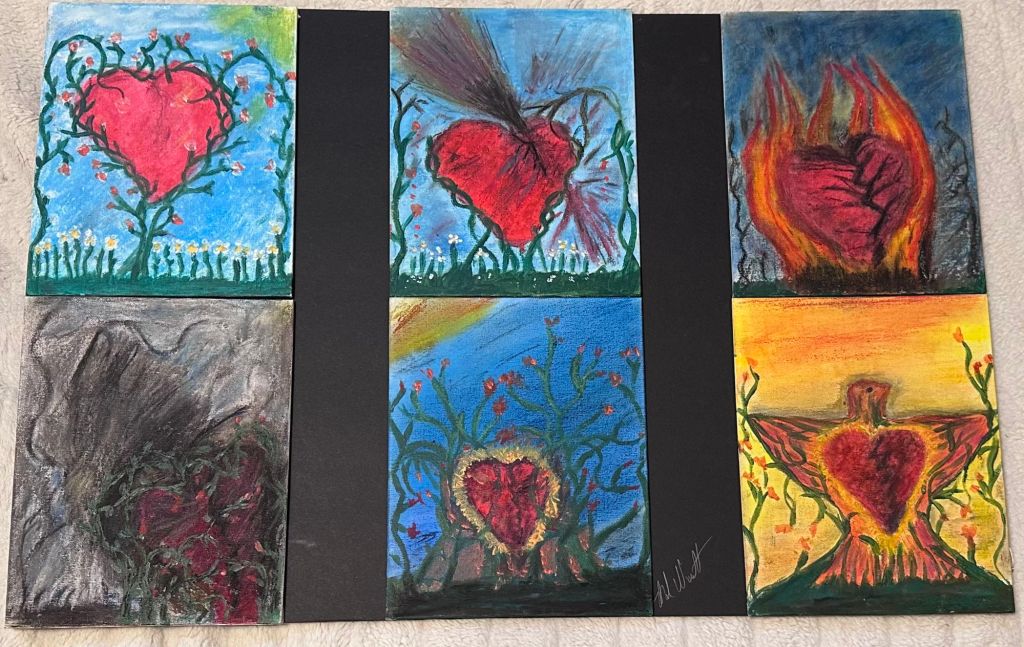
The six hearts came before I understood why there had to be six.
Because how does one heart describe how a beautiful life that once held longing, hope, purpose, and possibility became a battlefield of destruction that no one else could see?
The damage was not visible in my physical appearance, yet internally, I was being torn apart.
One heart could not tell that story. The damage itself could not either. It became a festering wound that tried to kill me slowly enough that even I could barely notice.
The first heart is colorful, vibrant, pure.
It has fine, small, intertwined vines—nothing sharp, nothing controlling. They are simply part of it.
There is an abundance of light. Innocence, love, and happiness without question or delay. Hope grows everywhere. Growth is made of a world of possibilities.
The heart does not question itself. It does not brace for anything. It simply exists.
Safety is natural, normal—a given.
There is an innocent longing.
Hope.
Purpose.
Possibility.
The belief in a happy ending is natural, even when life is difficult. There are dreams that something beautiful is ahead.
The second heart is where life begins to change.
The darkness moves in ever so slowly.
The thorns take root and grow stronger as they thrive on darkness. The painful thorns begin wrapping around the heart, just a little at first.
Not enough to panic.
Not enough to fully understand.
Simply enough to know something is different.
Something is wrong.
The darkness begins moving in. It does not crowd out hope or love, but the heart begins questioning its existence because the thorns have slowly caused pain. The darkness creates force fields and safeguards to protect the heart.
The darkness does not take everything.
There is still light.
There is still a recognizable version of the life that existed before.
But now there is awareness.
Caution.
The darkness begins to numb the senses because love is starting to become painful and frightening.
And this awareness changes everything.
The third heart is the beginning of the end.
Not breaking.
Not shattering.
Melting.
The pain becomes unbearable, far too intense to maintain a grip on hope.
The colors begin to run. The edges no longer hold their shape. The thorns tighten, and the darkness spreads farther across the heart.
There is still something that resembles the mind that once was, but the darkness begins to win, and the heart begins to burn. The darkness no longer controls only itself; it conquers the light as well, nearly burning everything to the ground.
The mind no longer knows how to hold itself together, and with it, the heart begins to be consumed.
This is the part people do not always understand.
A person can still look like themselves while everything inside their mind is collapsing.
Still go to work.
Still answer questions.
Still solve problems.
Still smile when someone speaks and engages them.
They can still be the caregiver.
Still perform the tasks required of an ordinary life.
And all the while, their heart is melting beneath the burning mind, hidden beneath the smiling mask.
The fourth heart is almost entirely consumed by a feelingless numb existence.
It is almost entirely dark.
There is very little hope.
The pain is too great.
Happiness has left.
The heart has allowed so much darkness to enter the mind that the vines are now a circle of thorns, which have nearly swallowed the heart completely. Almost all hope is lost, and the wounds are deep. The mind does not want the heart to be visible. It allows the darkness to surround it.
Yet this is not sadness.
It is something deeper.
The person you once were becomes so distant that the realization sets in, and you begin to wonder whether you ever existed in any version you knew.
There is no clear beginning or ending to the pain anymore.
No clean line between the heart and the darkness of the mind.
Only survival.
Only the smallest remaining spark of the mind, a piece still beating in the heart beneath everything that tried to bury it.
This is the battlefield no one sees.
The one no one should ever have to imagine or experience.
Yet from the outside, no one looks into your eyes and sees the black hole of numbing existence you have fallen into.
From the outside, they believe you are fine.
Sometimes you keep the mask on because even you want to pretend to believe that you are happy.
There may be no blood.
No broken bones.
No visible wound.
Nothing concrete that the world can validate.
Only numbness for the heart and emptiness for the mind.
Inside, everything familiar has been destroyed.
Safety.
Trust.
Identity.
Hope.
The ability to believe your own body when it tells you that you are safe becomes impossible.
This creates the worst wound because somehow, you are still expected to walk through the world as though nothing happened.
Only the fifth heart has some ability to allow hopes light to begin to return.
This occurs by sheer force of will.
A desire to see another sunrise.
A belief that the small spark of sunrise—of hope—is truly a reality and not some sort of cosmic joke.
But the light does not defeat the darkness immediately.
It is a slow, painful process, and it does not occur all at once.
It isn’t dramatic.
Only a very small section of purpose opens.
A sliver of color, light, warmth, and meaning.
The mind becomes a place where the darkness no longer owns everything.
But the heart grows back slowly and smaller. Sometimes a different shape or purpose is the only way growth can begin.
Flowers begin growing around the thorns again—the ones allowed this time around, the ones chosen to help growth have meaning again.
The thorns have not disappeared.
They are evidence that the mind grew differently, more cautiously.
The flowers grow beside the thorns, not to reflect the pain they created, but in spite of them altogether.
The heart is not restored to what it was before.
The mind changed it forever.
Instead, it is becoming something else.
Something better, more relentless, and far more resilient.
Something both wounded and living at the same time.
Fear still exists.
So does grief.
Along with all the memories as proof of existence.
Some days, the darkness still feels closer than anyone wants.
But growth has also brought other things.
Understanding.
Voice.
Connection.
Truth.
And perhaps most importantly, the realization that survival was never supposed to be the end of the story.
The final version of the heart has grown into something extraordinary.
The mind finally realizes it could never return to the version of the heart that existed at the beginning.
Instead, it had to grow into something new.
The untouched light of the first heart is gone.
The mind is different because the first heart believed in possibility without ever having learned darkness or fear.
The final version of the heart believes in possibility because it survived what tried to destroy it.
It also understands that survival is not the same as healing.
Healing does not erase the pain or make it as though it never happened.
The heart carries every stage that came before it.
The darkness was fought against for long enough and hard enough that the heart learned something it did not know before:
Darkness can exist without being allowed to own everything.
The heart begins to live more deeply and more colorfully.
The flowers open again.
The thorns that remain are woven into the landscape by deliberate design. They are not hidden or denied, but they are no longer allowed to decide what grows there.
That is the difference.
Before, life simply happened around the heart.
Now the heart chooses.
What it protects.
What it allows near it.
What it feeds.
What it lets grow.
The darkness did not disappear.
Neither did the memories.
They became part of the landscape instead of the entire horizon.
The heart is no longer melting.
It has found its shape again.
Not the same shape.
Its own shape.
The shape it created after discovering that healing was never going to mean becoming the person who existed before the battlefield.
Growth comes from knowing that the past does not have to be exposed for everything to see, nor does it have to be hidden away as though it never existed.
The past becomes knowledge.
And that knowledge gives hope something it never possessed before:
Information.
The heart now knows there will always be darkness somewhere in the world.
It knows safety can disappear quickly.
So the heart guards itself differently now.
It remembers grief.
Fear.
Numbness.
Complete emptiness.
It does not have the ability to forget what those things felt like.
Yet it still chooses to believe there can be something beautiful ahead.
It fights for growth.
It learns again that there is a world of possibilities.
But because of everything it has been through, it understands something the first heart never had to understand:
Possibility is no longer assumed.
It has to be chosen.
The heart cannot erase the devastation the mind endured during its fight on the battlefield.
But it can allow itself to grow beyond it.
It no longer hides its broken pieces from the world.
It wears them as evidence that it survived.
The scars do not have to be discarded or covered because harm is not something that simply disappears when it is locked away.
Given the right light, the right sun, and the right direction, even the places shaped by pain can become part of something living.
The heart gets to decide what remains.
Some thorns become boundaries.
Some are no longer given space.
Some of what once represented pain becomes evidence of growth.
And none of it has to be carried with shame.
The broken pieces are not proof that the heart became less beautiful.
They became part of something far more beautiful than it ever imagined it could become.
This is why the heart allows flowers to grow again.
Because this time, it wants them there.
The flowers are not accidental.
Neither is the light.
They are chosen.
The heart allows the mind to build around the thorns without pretending they never existed.
It decides which ones remain as boundaries and which ones no longer deserve space.
The flowers grow because they are wanted there.
The light exists because the heart fought long enough to find it again.
This heart is not evidence that I returned to who I was.
It is evidence that I became someone I could not have imagined before.
Not untouched.
Not without scars.
Not without darkness.
But alive.
Aware.
Choosing.
Growing.
Becoming mine.
Maybe that is why there had to be six.
One heart could have shown pain.
One heart could have shown recovery.
But one heart could never have shown the entire war.
The innocence.
The warning.
The collapse.
The disappearance.
The return.
The becoming.
For so long, I looked at what happened to me as evidence that something inside me was defective.
I saw the panic.
The anger.
The confusion.
The exhaustion.
The hypervigilance.
The pieces of myself I could no longer reach.
And I blamed the heart for what had wrapped itself around it.
But I am not the villain of this story.
I am not the darkness.
I am not the thorns.
I am the heart that remained beneath them.
And I am still becoming.
 Becoming Unboxed