They Thanked Me for My Service. I Was Begging Them for Help.

I spent nearly half my life as a proud public servant. Twenty-six and a half years, to be exact.

How do you explain being a woman who proudly dedicated more than twenty-six years of her life to serving the people of Arkansas, only to find herself fighting the very government she spent her career serving?

How do you explain going from being a confident, respected professional to spending approximately nine months isolated in a windowless room?

How do you explain providing medical documentation, requesting reasonable accommodations, following procedures, and eventually seeking help from the highest office in the state, only to continue feeling unheard?

And perhaps the most important question of all:

Who protects the people who find the courage to speak up?

I used to believe that if I fought hard enough, someone at the top would care. That if the Governor of Arkansas knew what was happening inside the walls of one of her agencies, she would say, “Enough.”

But how would she know?

When an employee repeatedly asks for help, how far do those concerns travel? Who is responsible for ensuring they reach someone with the authority to act?

I didn’t know.

I still don’t know exactly what reached Governor Sarah Huckabee Sanders personally.

What I do know is that I spent more than twenty-six years serving the State of Arkansas, and when I desperately needed someone to help me, I found myself fighting to be heard.

The Woman I Used to Be

I was proud of my work.

I appreciated the citizens I served, the relationships I established, and the taxpayers whose contributions paid my salary.

I believed in the rule of law and doing what was right.

I never assumed doing the right thing would always be easy. I asked questions. I challenged decisions. I wasn’t always the easiest person to agree with.

But I believed that when something wasn’t right, we had a responsibility to fix it.

On December 11, 2023, I experienced a sexual assault during my lunch break.

I reported what happened.

I never could have imagined that the events and decisions that followed would nearly destroy the woman I had spent a lifetime becoming.

I was transferred away from the workplace and county I called home, away from the community I had watched grow and helped serve for decades.

The professional relationships, responsibilities, and identity I had spent years building were suddenly changed.

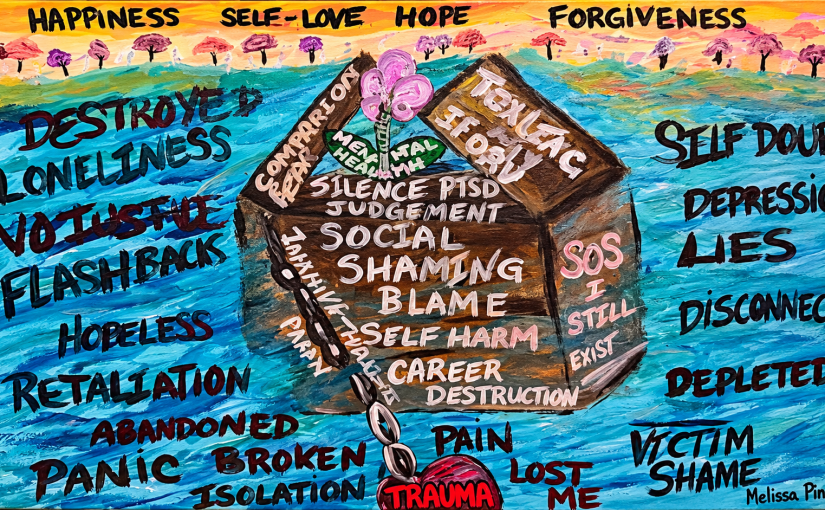
Eventually, I was placed in a small, windowless workspace that I came to call “the box.”

For approximately nine months, there were no windows, no ordinary conversations with coworkers, no stopping by someone’s desk, and none of the everyday human interactions most people never give a second thought.

I was still an employee.

I still had a job to do.

But the physical circumstances of my workplace meant I could no longer interact with the community the way I once had.

Nobody had to explicitly tell me I was forbidden from seeing people.

The arrangement itself prevented those interactions.

Whether complete isolation was the intention or not, I lived with its consequences.

And I began losing the woman I had once been so proud to be.

The Agency That Was Supposed to Protect

There is an irony I have struggled to understand.

The Arkansas Department of Health is an agency whose mission centers on protecting the health and well-being of the people of Arkansas.

It works to protect children, promote public health, and connect people with resources during some of the most vulnerable moments of their lives.

We encourage people experiencing violence to seek help.

We tell people struggling with their mental health that their lives matter.

We promote prevention, intervention, and support.

Yet I was an employee of that very agency, trying desperately to recover from trauma while believing that the circumstances of my employment were making my recovery more difficult.

I provided medical documentation.

I requested accommodations.

I sought extensive treatment.

I followed procedures and continued performing my duties.

All while trying to hold on to the professional identity I had spent decades building.

I couldn’t understand how an agency dedicated to protecting people’s health could leave one of its own employees feeling so unprotected.

I couldn’t understand why the principles we promoted to the public seemed so difficult to find when I needed them myself.

And I couldn’t understand why I had to fight so hard simply to continue working while trying to heal.

A Governor Who Speaks of Families and Mental Health

As a woman and a mother, I have listened to Governor Sarah Huckabee Sanders speak about the importance of families, children, and mental health.

I have watched policies change to provide benefits to mothers that were not available to me when my own children were born.

I am glad that mothers today have opportunities and protections that women before them did not receive.

Progress matters.

But I also know what it feels like to be a mother, a woman, and a longtime public employee whose needs seemed to fall somewhere outside those public commitments.

How can we advocate for mental health while allowing employees to struggle under working conditions they believe are harming their recovery?

How can we encourage women to speak up about violence while leaving those who do speak up feeling abandoned?

How can we say families matter without recognizing what happens to an entire family when one person is struggling simply to survive another day?

These are not questions I ask because I oppose progress.

I ask them because I believe those values should apply to everyone.

Including the people who serve the government itself.

They Thanked Me for My Service

Eventually, I reached out to Governor Sanders’s office.

More than once.

I wanted someone to understand what had happened to me.

Not simply that I was unhappy with my job.

Not that I disagreed with a supervisor.

But that I had experienced a sexual assault, that my life had changed, and that I was desperately trying to recover while continuing to serve the state.

I later received a response from the Governor’s office.

It thanked me for my service.

And I want to be fair about that.

Someone responded.

Someone acknowledged my years of public employment.

But what I needed was more than acknowledgment.

I needed to know whether anyone had examined the circumstances I was describing.

Whether anyone had questioned how an employee with decades of service, medical documentation, and requests for accommodation had reached such a desperate point.

Whether anyone was willing to look beyond the correspondence and see the human being behind it.

The response did not provide those answers.

I cannot say what Governor Sanders personally knew or whether she ever read my letters.

But I can tell you what receiving that acknowledgment felt like.

They thanked me for my service. I was begging them for help.

And those are two very different things.

When Being Heard Becomes Another Battle

There is something particularly painful about trying to explain suffering to an institution through paperwork.

You learn to document everything.

Dates.

Conversations.

Medical appointments.

Requests.

Responses.

You become increasingly skilled at describing what happened while becoming increasingly exhausted by the need to explain it.

At some point, you begin to wonder how many times a person must ask for help before the request becomes something more than another document in another file.

I had spent my career believing in procedures, regulations, and accountability.

I knew why those systems existed.

But I also began to understand something I had never fully appreciated before.

A person can follow every procedure available to them and still feel completely powerless.

And the emotional consequences of that experience do not disappear simply because someone sends a polite letter.

Trauma changes how you experience the world.

It changes how sounds feel to your nervous system.

It changes your confidence, your concentration, your relationships, and sometimes even your willingness to leave your home.

Perhaps one of the hardest parts is remembering exactly who you used to be while desperately trying to understand why you cannot simply become that person again.

I missed her.

The woman who could walk into difficult situations without fear.

The woman who could challenge a decision and look someone directly in the eye.

The woman who believed she could make a difference.

I wondered whether I would ever find her again.

For too long, I wasn’t really living.

I was surviving until tomorrow.

And then trying to survive until the tomorrow after that.

Something Began to Change

Somewhere during that struggle, I began putting my experiences into words.

I began turning my pain into stories and art.

Not simply to describe what had happened to me, but because I wanted other people to recognize something of themselves in what I was writing.

The people carrying pain the world cannot see.

The people expected to continue functioning while their minds and bodies are struggling to survive.

The people who have been told to speak up, only to discover how difficult being heard can become.

I am not an angel.

I am not a saint.

And I am certainly not fearless.

But through all of it, one thing remained.

I still showed up.

I showed up even while afraid.

I showed up when I felt exhaustion in every fiber of my being.

I showed up when it would have been easier to disappear and allow my story to scatter into the wind like dandelion seeds.

Not because I had conquered every symptom or erased everything that happened.

But because I was beginning to understand that what happened to me does not get to decide the person I will become.

More Than an Acknowledgment

Somewhere along this journey, I began to recognize that this story was no longer just about me.

It was about every employee who has ever been afraid to report something wrong.

Every survivor of sexual assault who has questioned whether speaking up is worth the consequences that may follow.

Every person who has followed the rules, asked for help, and found themselves fighting a system they believed should protect them.

If this can happen to someone with decades of public service, professional expertise, medical documentation, and the determination to stand up for herself, what happens to the employee, the survivor, or the person who is too afraid to speak?

That is the question I cannot walk away from.

And it is why I want something more than an acknowledgment.

I am fighting for change.

I want protections that do not depend on how persistent an employee is or how many times they have to beg someone to listen.

I want meaningful accountability when a public employee reports an assault and subsequently experiences isolation, loss of professional responsibilities, or serious difficulties obtaining necessary accommodations.

I want independent oversight so employees are not left relying entirely on the institutions whose decisions they are questioning.

I want a system where seeking help does not become another battle that consumes years of someone’s life.

I want Melissa’s Law.

Not because I believe a law can erase what happened to me.

It can’t.

A law cannot give me back the nights I spent afraid, the months I spent isolated, or the pieces of myself I have struggled so hard to recover.

But perhaps it can help prevent someone else from experiencing the same thing.

Perhaps it can help ensure that the next person who finds the courage to speak up receives something more than a letter thanking them for their service.

Because public service should never require sacrificing your humanity.

And reporting an assault should not mean spending the following years fighting to recover your identity.

Becoming Heard

For more than twenty-six years, I served the people of Arkansas.

When I needed someone to protect the dignity and humanity I had spent my career extending to others, I found myself fighting to be heard.

I cannot change December 11, 2023.

I cannot recover every day I spent fighting to survive.

But I can decide what happens next.

For too long, all I was trying to do was survive until tomorrow.

Now, I want to believe in myself walking into tomorrow.

I have spent years trying to make people understand what happened to me.

Today, I want people to understand why it matters for everyone.

Because somewhere there is another employee afraid of losing a career. Another survivor wondering whether anyone will believe them. Another person who has convinced themselves that remaining silent is safer than asking for help.

Their voices matter.

Their dignity matters.

Their health matters.

And they deserve more than an acknowledgment.

They thanked me for my service.

I was begging them for help.

Now, I am demanding change.
The Woman in the Flowered Nightgown

–An Unexpected Journey Back to Belonging–

Saturday morning, I looked at my daughter and told her something I hadn’t been able to believe about myself for a very long time.

I deserve a seat at the table.

I didn’t know that before the morning was over, I would find myself sitting on a stranger’s couch, in a neighborhood I’d watched grow from almost nothing, remembering what it felt like to belong.

But first, I had to convince myself to leave the house.

–The Morning After Friday Night Lights–

The night before had been difficult.

I’d driven an hour and a half to Greenwood, Arkansas, to watch my son play football. A year earlier, I couldn’t have made that trip. My nervous system was so devastated that I could barely leave my own property, much less tolerate a stadium filled with screaming students, marching bands, fireworks, and flashing lights.

I’d forgotten my Loop earbuds. Again.

The traffic down the mountain had already sent my nervous system into fight mode, and the stadium only added to the overwhelming stimulation.

Yet somewhere in that difficult evening, something beautiful happened.

A woman sitting nearby gently touched my leg and asked if I recognized her.

I didn’t recognize her face immediately, but I recognized the kindness in her hand.

She was the therapist from my first art class through the Northwest Arkansas Center for Sexual Assault, one of the first places I began finding my voice again after so much isolation.

Of all the people who could have been sitting beside me that night, there was someone who had helped me begin returning to the world.

We arrived home late, exhausted, and I struggled to sleep knowing what I had committed myself to doing the following morning.

The irony was that I had volunteered to go canvassing for Tim Shepherd, one of the candidates running for Washington County Judge.

Which, in all honesty, was something I’d never chosen to participate in before.

And my mind desperately wanted to talk me out of it.

I Knew I Could. I Just Didn’t Know If I Had It in Me to Actually Follow Through with doing it.

I had spent 26 and a half years working in state regulatory government, you wouldn’t think knocking on a stranger’s door would seem difficult.

Over the span of my career, my normal job duties required walking onto people’s properties, answering uncomfortable questions, explaining complicated regulations, resolving internal and external conflicts, and sometimes informing people about things they really didn’t want to hear.

It wasn’t that I didn’t know how to talk to people.

My reality is that I have a master’s degree in conflict resolution. I have an educational background in how to communicate effectively, especially when situations become uncomfortably tense.

But now that I live with CPTSD, things have changed.

The neurological effects of trauma have changed how I respond to conflict and stress, causing me to question the reality I once knew.

The idea of a positive interaction didn’t frighten me.

It was the possibility of a negative one.

What if someone became angry?

What would I do if something got heated?

Could I control my responses?

Was I capable of recognizing when I might need to remove myself from a particular situation?

Saturday morning, I got up and headed out anyway.

I quickly got ready and chose to put on a sweater covered in hearts, my red pants, and the red boots I’d worn the night before because, quite frankly, they were easy to find.

My house and my life still feel like one giant cluster of chaos. There are times when I still struggle as I try to pull myself out of old habits and back into the land of the living.

It was at that moment that I looked at my daughter, December, and explained why I wanted to participate.

I deserved a seat at the table.

I had spent 26 and a half years caring for the citizens of Washington County. I knew its people, its growth, its history, and I cherished the relationships that had developed over decades.

I didn’t know whether this experience would lead to anything professionally.

That was not my goal.

I simply wanted those years when I had been seen as someone valuable to mean something beyond my past.

I wanted to choose what I was allowed to contribute.

I wanted a choice in how I became part of my community again.

–Finding My Place at the Table–

I arrived two minutes late.

Nothing unusual. It is something of a running joke with my family.

There were about a dozen volunteers gathered in the parking lot, most of whom I’d never met.

Tim greeted me by name and shook my hand.

People were introducing themselves, discussing assignments, and demonstrating a canvassing app that fascinated me.

It was remarkable to see how technology had changed the process of reaching voters.

But as the instructions continued, I realized they expected us to go knocking on doors individually.

My stomach sank.

As uncomfortable as it was, I had to explain that I needed someone with me.

I have learned through this process that sometimes my comfort has to come first.

Explaining the kind of fear CPTSD can create to someone who hasn’t experienced it is difficult.

Fortunately, everyone understood, and assignments were made so we could share districts and canvass together.

It was decided that we’d met a little too early on Saturday morning, so we chose to gather at a coffee shop before heading into the neighborhoods to start knocking on doors.

The coffee shop just so happened to be the same one where I’d previously spent an hour and a half talking with Tim a few months earlier.

That brought some much-needed relief to my anxiety.

Meeting Tim in June was one of the first times someone outside my workplace helped me recognize the side of myself that had almost been extinguished by the multiple transfers and removal of job duties I’d experienced since 2024.

Knowing your surroundings helps when you suffer from CPTSD.

New places can wreak havoc on an already overwhelmed nervous system.

That decision alone made a huge difference in the outcome of the rest of my day.

I ordered a chai and a scone, even though I was too anxious to really enjoy either one.

The group had already chosen a table in the middle of the room.

The irony of living with CPTSD is that you desperately want to feel in control of your surroundings, yet here I was, trying to figure out where I could sit to ease my nervous system.

My first choice was to attempt to sit with my back to the door.

I quickly realized how uncomfortable that made me.

So I repositioned myself with my back toward the wall.

When your nervous system has spent years expecting danger, even choosing where to sit requires thought.

There I sat.

By choice.

No longer hidden.

I was earning my seat.

At a table with people who hoped to serve Washington County, Arkansas, my pride and joy.

I got to have real discussions with Hayden Hill, a young man running for county treasurer, and a tall, well-spoken college student with blond hair and glasses who looked closer to 30 than 19.

He was a University of Arkansas student interested in becoming a criminal attorney someday.

As we spoke, I told him I never would have guessed he was 19.

His response was comical.

“I wish the bouncers at the club believed the same.”

That made me laugh, and memories of a lifetime ago, including my own underage visits to clubs, flashed through my mind.

Our conversations allowed me to learn about their backgrounds and aspirations.

I discussed my three degrees, including my master’s degree in conflict resolution, and the years I’d spent working in Washington County.

I talked about being an outsider who had been invited into county government discussions by some of the most respected county judges of the past 30 years.

I had promised myself I wouldn’t share my trauma history.

I don’t want it to be what defines me.

Unfortunately, to explain how I got where I am today, I sometimes have to share enough of my story for people to understand why being included at that table mattered so much.

I’ve gotten good at not sharing the graphic details.

Over the last almost three years, I’ve practically perfected the ability to explain what happened without sharing everything I’ve endured.

I’ve become fluent in sharing just enough for someone to understand the shocking extent of the damage I’ve experienced, and why I care so deeply about the county and humanity in general.

In my experience, my story touches the majority of people I choose to share it with.

The response is almost always the same.

People begin telling me how sorry they are for what happened to me.

It isn’t that I don’t appreciate compassion.

That’s not it at all.

I need the compassion.

But I also want people to see me beyond what happened to me and how my employer reacted.

I want to be seen as someone who still has something to contribute to society.

–The First Doors–

Eventually, we all headed to the same subdivision so those of us who were new to canvassing could have someone with us.

It was a neighborhood I knew.

I’d inspected its swimming pool during my years working for the state.

Three of us started walking together while the others went in different directions.

Not that it’s particularly relevant, but we were the three women in the group.

I knew I was out of my comfort zone, so I allowed the other two women, who were more seasoned in canvassing, to lead us.

At that point, all I wanted to do was observe.

That was about all my nervous system would allow.

At one of the first houses, a gentleman came out who seemed cautious about our approach and why we were there.

He asked pointed political questions, including whether Tim supported Donald Trump.

He identified himself as a die-hard Democrat.

And here I was, standing there as someone who had been a registered Democrat most of my life, volunteering for a candidate running on the Republican ticket.

Most people would probably question that choice.

I chose a campaign, not a party.

Because of that political affiliation, I suddenly felt drawn to explain why I believed Tim was the most qualified candidate for the job.

I gave my perspective.

I explained that my years in government had taught me to look beyond party labels and consider the individual.

I shared why I believed Tim’s experience and approach to public service deserved consideration.

The gentleman listened.

He said he’d look into it.

And we moved on.

To my astonishment, there had been no argument.

No confrontation.

No need for fear.

My body was starting to relax.

The old me was beginning to reemerge.

I had spoken with someone who held strong political opinions, and we’d simply had a conversation.

Something that once came naturally to me was beginning to feel possible again.

And as my body began to ease, the canvassing continued.

But the most meaningful conversation of the day was still waiting around the corner.

–The Woman in the Flowered Nightgown–

We knocked on another door, and a gentleman answered.

His wife was saying something from inside the house.

At first, he seemed to think she wanted him to close the door.

But that wasn’t what she was saying.

She wanted to hear what we had to say.

A few moments later, she made her way to the doorway with her walker.

She invited all three of us inside.

Her home was beautiful. Immaculate. The kind of home that reminded me of my own mother.

Her husband offered us water, and she invited us to sit on the couch.

I sat closest to her.

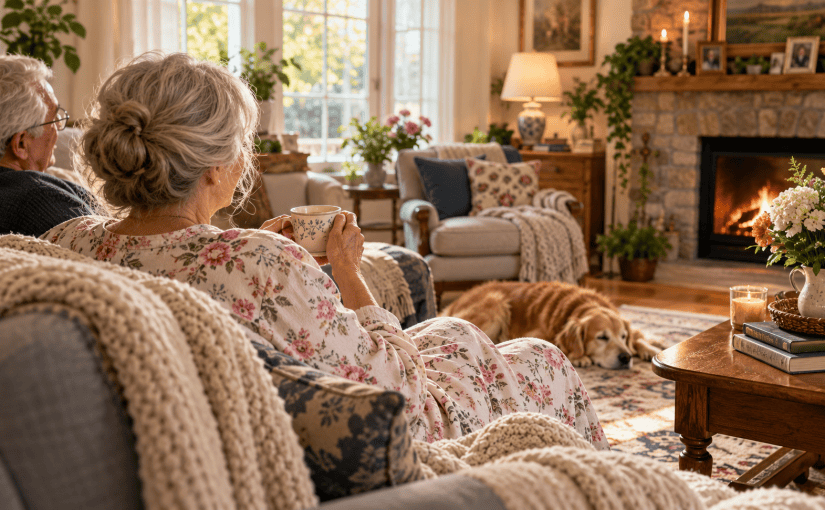
She was wearing a flowered nightgown, the kind that honestly looked more like one of the little dresses young women wear these days.

She apologized for her appearance.

It wasn’t that I couldn’t understand why she was apologizing.

I understood it all too well.

When you feel insecure, sometimes the first thing you do is apologize for the shortcomings you believe other people might see.

But in my eyes, she was absolutely beautiful.

There is something to be said about beauty and aging. About the grace of a woman who has lived a life and shouldn’t have to apologize for being comfortable in her own home.

She told us she’d been ill and had undergone surgery.

She wasn’t sure she’d be able to get out to vote and thought she might need a mail-in ballot.

But she wanted to hear about the candidates.

She wanted to participate.

And that’s when something inside me began to open.

I started talking about Washington County.

Not from a political script.

Not from a campaign advertisement.

But from 26 and a half years of watching a community grow.

I spoke about the changes I’d witnessed, the responsibilities of public service, and why integrity mattered so deeply to me.

I gave my explanation of why I’d chosen to support someone whose approach to leadership I believed in.

For the first time that morning, I wasn’t thinking about whether I could speak to a stranger.

I felt drawn into a conversation with someone whose perspective I wanted to understand.

Someone I wanted to show kindness to.

Someone I wanted to share something meaningful with.

About something I loved.

At one point, she looked down at Hayden’s campaign card.

“Now, he’s a nice-looking young man,” she said.

I smiled and agreed.

That gave me an opening to explain what I’d just learned earlier about Hayden Hill and why I believed he would be a good fit for the position he was running to fill.

Somewhere during that conversation, I noticed a tiny tear in this lady’s eyes.

I’m not sure why it was there.

Perhaps she was emotional about her health.

Perhaps she appreciated having company.

Maybe she was feeling something I recognized in myself.

I’m not going to pretend to know what she was thinking.

But as I sat beside her, I remembered what it felt like to be stuck in a life you no longer recognize.

Stuck in a life you didn’t necessarily choose.

Forced to live a life where your health determined where you could go, what you could do, and how much of the world you could participate in.

A life where you wanted your voice to be heard.

Where you wanted to know you still had enough value to sit at the table and contribute to society.

Dreaming of a life where people would see more of you than whatever was holding you back or disabling you at that moment.

I knew those feelings all too intimately.

And it made me wonder whether, in some small way, she felt some of the same things.

When it was time to leave, her husband offered us cookies or a banana.

We thanked them for their kindness and continued walking.

As we left, Yolanda, one of the women canvassing with me, commented on how my years of experience and personal testimony about Washington County had contributed to the conversation.

And I felt something I hadn’t felt in a long time.

Pride.

Not because I’d persuaded anyone.

But because I’d remembered who I was.

The Beauty of a Second Encounter

A little later, as we made our way back toward our vehicles, we passed the same house again.

The couple was standing outside.

She was still in her flowered nightgown, and her husband was beside her, holding onto her clothing to help steady her.

The tenderness between them was beautiful.

Hayden happened to be walking nearby.

I introduced him.

I told him she’d said he was a good-looking young man, and I was sure his wife would agree.

We all laughed, and I added that while his looks might have caught her attention, his intelligence was the real treasure.

I believed Washington County would be proud to elect someone with his knowledge and experience.

She apologized again for her appearance, and I wondered whether meeting this young man had made her feel a little self-conscious.

I glanced back at her and told her again how beautiful she was and that she had absolutely nothing to apologize for.

Her nightgown looked like one of the dresses all the young ladies wear these days.

In my opinion, she was fashionable, beautiful, and amazing.

She giggled.

And I suddenly realized that I was talking to strangers.

Making someone laugh.

Complimenting a stranger because I genuinely wanted her to know how beautiful I thought she was.

With every conversation, it became more apparent.

The woman I’d missed so desperately was returning.

By this point, Hayden had begun speaking with the couple.

That’s the nature of running for political office. He shared his history and his desire to earn their vote, and when he left, they proudly placed his sign in their front yard.

We all went our separate ways.

Looking back, I realize I had no idea that the most difficult part of the morning was still ahead.

–The Swimming Pool–

I chose to move my car to the nearby parking area in front of the subdivision’s swimming pool.

A pool I had inspected for years.

And that’s when memories of the past came flooding back, haunting my present.

I remembered Cody.

A sweet young man who worked for the POA, someone who had always treated me with kindness and respect.

I remembered looking at a pool pump with him one day when a valve opened and sprayed water directly into my face.

He apologized, and I laughed because earlier that same day, I’d been at a septic system when someone struck a line with a shovel, and sewage water erupted like a geyser.

So when that clean pool water hit my face, all I could think was, Thank God it wasn’t sewage.

I laughed, thinking it would be a story to tell my grandchildren someday.

Those were the memories that made me really love the work I did and the community I was proud of.

Those stories were the kind that never made it into inspection reports.

The personal, honest human connections and conversations were bonuses between the responsibilities of the job.

Cody heard my horrible story in 2024.

Then, in 2025, he asked me to open the pool for the season.

The heartache I suffered when I had to explain that I was no longer allowed to do that work broke me even more.

Yet all he said was that he would pray for me.

I’ve only seen him one time in my community since, at the UPS Store.

I pray to this day that he’s thriving because he’s an incredible human being.

As I sat there in that parking lot, I realized how much I missed him.

A wave of grief ran through me.

I deeply missed not just Cody.

I missed all of it.

The people.

The conversations.

The relationships.

The community and the county I had watched grow for over a quarter of a century.

Suddenly, the pride I’d felt only moments earlier was overwhelmed by grief.

And only in that moment did I realize something I hadn’t fully understood before.

Washington County had been like a first child in my heart.

–Grieving the Loss of My Home–

I moved to Washington County in 1980, after my father’s death.

I grew up here.

It’s where I learned about small-town politics, community relationships, and the importance of knowing the people you serve.

My government career allowed me to find something that had been missing from much of my life.

Strength.

Conviction.

Purpose.

Respect for others and, perhaps most importantly, respect for myself.

It allowed me to stop seeing myself as the abused girlfriend, the woman who had been told she wasn’t smart enough, or someone who needed another person to protect her.

It allowed me to become the person who protected other people.

My career allowed me to grow into the woman I’d always deserved to be.

Through it, I gained respect and confidence. I developed relationships that became part of my identity.

My children grew up knowing me as the woman everyone saw as an expert.

And I loved Washington County with everything I had.

Over the years, I watched empty fields become subdivisions.

Swimming pools get built.

I had the honor of witnessing communities become established, families grow, and people age.

For a quarter of a century, through changes in leadership, government policies, and the enormous growth of Northwest Arkansas, I stood alongside them and never wavered.

I cared for Washington County as if it were my own child.

I watched it take its first steps, learn to drive, go off to college, and build a home.

I protected it fiercely, within the laws and responsibilities of my position.

I was proud that I could put aside my own troubles at times to serve the people within its geographical borders.

There were times those interactions were the very things that allowed me to forget what was happening in my own life.

Yet the hardest thing to grieve is the fact that when I was hurt, the work I loved and the relationships that gave me purpose were taken out of my daily life.

In the very community that felt embedded in my DNA.

I wasn’t given even a single opportunity to say goodbye or find closure.

How do you explain that kind of grief to someone else, or the impact it has on your mental health?

How do you explain losing something that is still there, but you’re no longer part of it, even though you never chose to leave?

The people are still there.

The communities are still there.

The swimming pools are still there.

Life went on.

But I wasn’t part of it anymore.

It felt like raising a child, and then suddenly that child was dead.

I know those are difficult words.

But that’s the depth of the loss I felt.

I wasn’t simply grieving a career.

I was grieving the place where I’d learned to believe in me.

I was grieving my home.

–Becoming Unboxed–

Saturday didn’t magically fix my nervous system.

It didn’t erase the fear, the isolation, or the grief.

There were moments when I still needed someone beside me. Moments when I questioned whether I could participate. Moments when my memories became so overwhelming that I struggled to continue.

But I got up.

I went somewhere unfamiliar.

I asked for help when I needed it.

I sat at a table surrounded by people I didn’t know.

I spoke to strangers.

I laughed.

I remembered what it felt like to be respected for what I knew.

And I cried for everything I missed.

But perhaps the most meaningful part of Saturday was meeting a beautiful woman in a flowered nightgown.

A woman who wanted to hear what we had to say.

A woman whose husband stood beside her with such tenderness.

A woman who made me laugh and whose eyes have stayed with me ever since.

I told her I had a blog.

I hope one day to print this story and bring it back to her door.

Not because I need her to know everything I’ve survived.

But because I want her to know what those few moments meant to me.

I went canvassing because I wanted to reconnect with a county I’d spent my life loving.

I didn’t expect to find a piece of myself sitting in a stranger’s living room.

For so long, I’ve been trying to survive until tomorrow.

Now I’m trying to learn how to believe in myself walking into tomorrow.

Maybe becoming unboxed isn’t about returning to the woman I was before.

Maybe it’s about recognizing that the woman I worked so hard to become is still here.

Even with everything she’s carrying.

Washington County was my first child.

And although I may no longer serve it in the way I once did, I never stopped loving it.

I deserve a seat at the table.

Perhaps, for the first time in what feels like an eternity, I’m beginning to believe my life might be different but that is the only way to truly start Becoming Unboxed.

She Was Only 25

It took me 46 years to see my mother’s grief through the eyes of a mother.

For 46 years, I’ve carried the story of the little girl who lost her daddy.

Tonight, I found myself thinking about the young woman who lost her husband.

I feel as though I have spent most of my life trying to understand and overcome what losing my daddy at six years old meant.

Suddenly, 46 years later, I think I am beginning to understand what losing my daddy must have done to my mom.

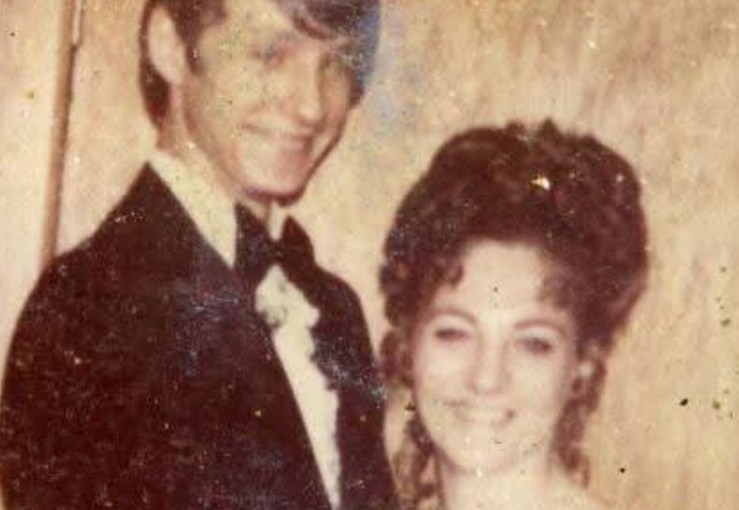
She was a widow at 25. She lost her happily ever after.

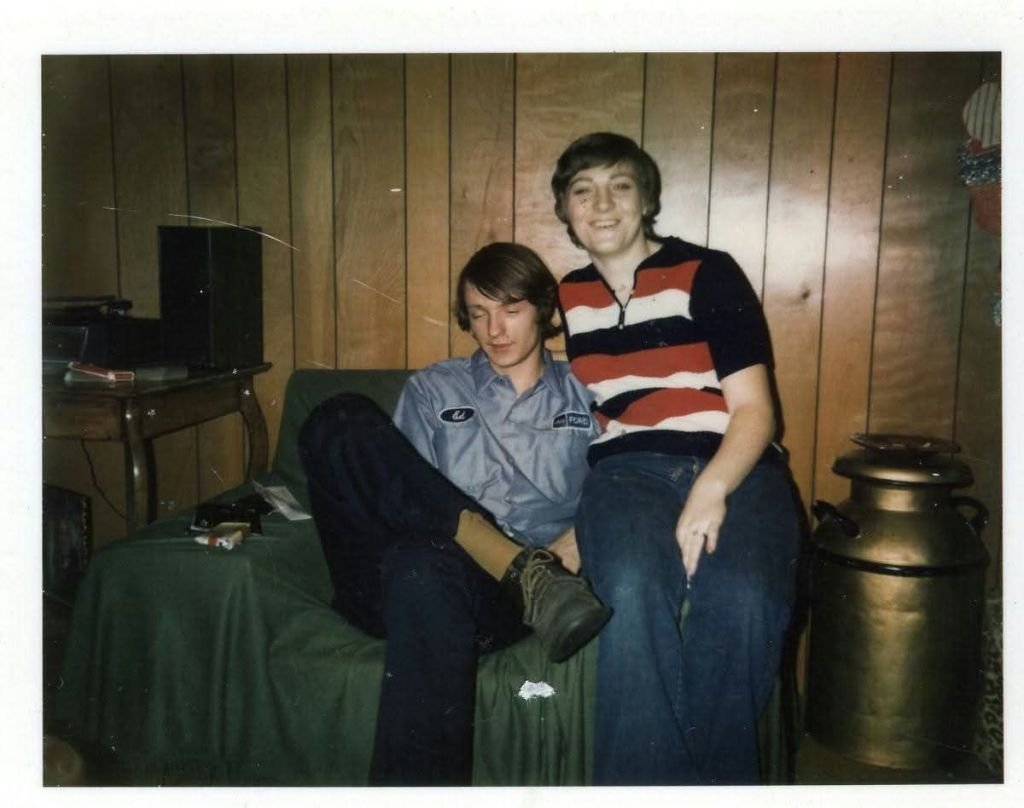
My dad was only 26, and he left behind a six-year-old daughter and a three-year-old son.

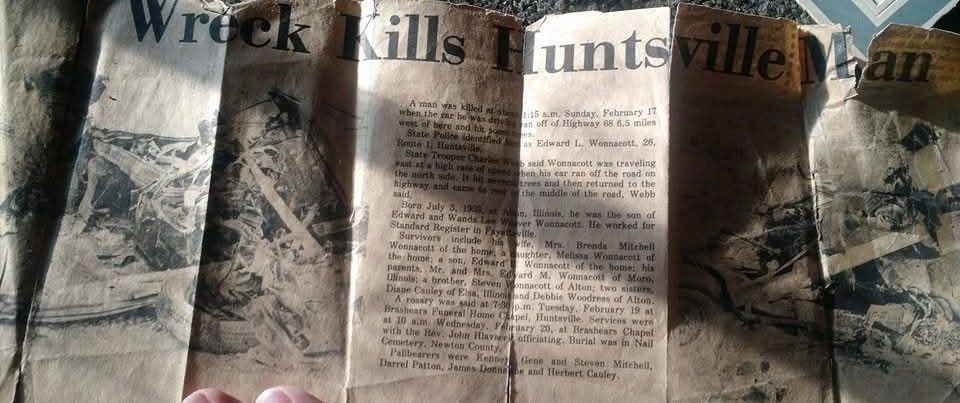
Tonight, I found myself going through a box of memories from February 1980. Things I have held dearly for most of my life. Pictures of the accident, some of my dad’s childhood belongings, and little pieces of a life that ended far too soon.

While I’ve literally had a lifetime to look at these things, tonight, for the first time, I really looked at them. I saw them for what they were.

There were sympathy cards, flower cards, and letters of sympathy from friends and family.

Among those small acts of kindness was the warranty for my daddy’s casket. Even the information about where his burial vault was made.

It was almost as though those things had suddenly appeared out of nowhere.

Probably because whenever I opened that storage box, I was always drawn to the things I loved seeing. His Boy Scout uniform, his wallet full of baby pictures, and the newspaper article showing the wadded mess of metal left behind after his 1974 Ford Torino struck four trees at a high rate of speed.

His school pictures, report cards, handwritten letters, and the little pieces of his childhood that my grandparents had saved.

And then there were the Valentine’s cards.

My mother’s handwritten words, “The one you picked, not just came along.”

And my daddy’s simple message, written in his own handwriting.

“I love you. Ed.”

I remember that my daddy bought my mother Dan Fogelberg’s Phoenix on 8-track. He thought 8-tracks were cool. Man, would he wonder at the world today.

On that 8-track was a song called “Longer.”

It was a love song, given to a woman who had no idea how little time she had left with the man who bought it for her.

All of these things I’ve kept for years, but somehow, tonight I saw them differently.

Suddenly, I was no longer looking at the souvenirs of an event I wished I could forget.

I was no longer looking through the innocent eyes of a six-year-old girl who had just lost her daddy.

I was looking through the eyes of a mother.

And for the first time, I could truly see how strong my own mother had to be.

I was mesmerized by her strength.

I can appreciate her more in this moment because I know what it means to have children depending on you when the pain becomes absolutely unbearable and you’re hurting yourself.

You can’t collapse.

You just tell yourself, “It’s fine.”

And you keep going.

It made me think about how incredibly strong she had to be.

All the decisions that had to be made. All the people she had to notify. All the arrangements that had to be handled.

The uncertainty of what the future might bring, or what tomorrow would even look like.

And through all of that, somewhere in the middle of everything, she was supposed to find time to grieve her happily ever after.

She was only 25.

I spent 46 years trying to understand what losing my daddy did to me, never fully considering what losing him must have done to her.

And tonight, surrounded by all those little pieces of paper, I finally saw something I hadn’t seen before.

Now I know where I get my strength from.

Now I know why I’m damned and determined that I will not give up.

I was taught how to fight by a warrior.

She was only 25.

The Art of Healing: Living with Trauma and CPTSD

For Whoever Needs This

If you are reading this because something inside you hurts, I want you to know something.

Maybe the noise won’t stop. Maybe the memories won’t fade. Maybe you are tired of pretending to be okay.

This was not your fault.

You did not deserve it.

And struggling does not make you weak. It means your body fought to keep you alive.

There may not be one cure, one medication, or one answer for all of us. But there is one truth I have learned again and again:

You deserve to be heard long before you feel healed.

If you feel like you’re running a marathon in quicksand, if even the smallest sound makes your heart brace for danger, if you’re afraid that no one will stay beside you when it gets hard, I understand that more than I can ever explain.

Maybe no one can fix you.

Maybe fixing was never the goal.

But please take this with you:

Strength is not never sinking. Strength is refusing to stay buried.

Your voice matters.

Your pain matters.

Your tomorrow matters, even if today hurts.

If nothing else, let these words be proof:

You are not invisible.

I see you.

And I believe you can make it through.


For the Friends and Family of Someone Who Suffers

If you love someone who lives with trauma, you may sometimes feel unsure what to do or be afraid of saying the wrong thing.

You might see them cry without warning.

Pull away when they actually need closeness.

Lash out when they are really just scared.

You may take it personally. You may feel helpless. You may even feel tired too.

Please know this:

They are not choosing their pain.

Their nervous system is reacting for them long before their logic even has a chance to even process the situation.

They are not trying to be difficult.

They are trying to survive.

You don’t need the perfect words.

You don’t need to fix it.

You don’t need all the answers.

Sometimes all they need is:

“I’m here.”

“I don’t fully understand, but I want to support you.”

“You don’t have to carry this alone right now.”

Sometimes the most powerful thing you can do is stay without trying to change them.

Because it’s not about rescuing them.

It’s about not abandoning them while they’re learning how to rescue themselves.

Even with good intentions, some phrases may cause harm:

“You just need to calm down.”

“Can’t you get over it by now?”

“But that happened years ago.”

“You’re too sensitive.”

“Other people have it worse.”

It may seem logical, but trauma doesn’t respond to logic.

It responds to safety.

To compassion.

To patience.

They are not broken.

They are rebuilding.

And they are still learning how to live in a body that remembers what they wish it could forget.

You may never fully understand what they carry. But if you can choose to walk beside them anyway, even when it’s messy, you will give them something that medicine never could:

Proof that they are still worthy of love and care.

That kind of presence is not weakness.

That is courage.

That is love.

And sometimes, that is what helps a survivor make it to tomorrow.


Part I: What CPTSD Really Is

All the years of abuse. All the traumatic instances. All the ways I had to survive financially, physically, mentally, spiritually, and in relationships.

I always had someone to lean on.

A therapist.

A lifeline.

Someone who could remind me that I was still here.

But the funny irony is this:

The week before it happened, the last time, the one I swore would never happen again, my therapist and I had just spoken.

We talked about how far I had come.

The night of the assault, I called her. I needed her, I knew I was not okay.

She said, “Oh my God, Melissa. You had come so far. You can get through this. You’re strong enough.”

I didn’t want pity.

I didn’t want advice.

I just needed someone to hear me.

As the weeks went on, it was my voice, not her answers, that saved my life.

Just telling someone, anyone, was enough to keep me from the unspeakable end of my existence.

They didn’t need to hear every detail.

They just needed to listen.

But ironically, that also became my downfall.

It was my voice that made someone uncomfortable.

It was my voice that triggered a complaint.

It was my voice they said talked about sex too much.

It was my voice that shattered the silence they depended on.

And my voice, once again, brought back the ugly history of my supervisor, somebody who had already tried to take my worth from me.

That is another chapter.

The nuclear bomb.

The one I haven’t fully written yet.

But when I was diagnosed with Complex Post-Traumatic Stress Disorder, everything suddenly made more sense.

And hurt more deeply.

We hear PTSD and we think of soldiers. The ones who come home from war and fear loud noises, sudden movement, fireworks in July.

We think of police officers and firefighters. People who see one horrific moment they can’t forget.

But some of us didn’t witness one moment.

We lived it on a constant basis.

We weren’t on a battlefield.

We were the battlefield.

That’s what people don’t understand about someone like me.

CPTSD is what happens when survival becomes your identity.

It’s when the people who were supposed to keep you safe became the reason you question if you deserve safety at all.

Here is what my war looked like:

A childhood with no positive reflection. No one to say, you’re good just as you are.

The loss of a father at six years old.

A mother who tried, but carried her own storms. Was a widow at 25 with a six year old and 3 year old who suddenly had to become all the things it takes to raise children, keep a house and do it all alone.

The joke about my first kiss that shattered my sense of worth.

A teenage boy who took advantage of my innocence.

Domestic violence wrapped up as love from boyfriends.

Black eyes.

Concussions.

A choice no woman should ever have to make about her own body.

A custody battle to protect my child.

A medical fight to save my daughter life from Type 1 diabetes every single day.

A marriage where I became the protector, the provider, the one who held everything together.

And finally, the detonator.

Sexual assault and entrapment.

And that became the breaking point, creating the flame and  the point of no return.

Followed with discrimination for being a victim by a state agency that exists to protect people like me.

That was the moment the war inside me finally said:

ENOUGH!!!!!


Part II: The Search for Relief

Once you obtain a diagnosis, you begin the next battle:

Trying to find anything that will ease the pain.

You bring the diagnosis to doctors.

To psychiatrists.

You hope that naming it will help fix it.

But naming it is only the beginning.

I was never formally 5150’d or institutionalized, but I’m not going to lie.

There were days when the thought crept in.

Days when I spoke to the professionals who cared for me and said:

“I don’t know how much longer I can keep going like this.”

You find good providers.

You try to find people who care.

You try every medication.

You go through the giant list of antidepressants, every pill that promises relief.

But nothing touches the pain in your mind.

Nothing eases the ache in your bones.

Nothing makes you feel like you again.

When you are deep in the throes of Complex PTSD, you start to forget who “you” even is.

And when you’re also ADHD, your PTSD becomes like the Incredible Hulk climbing the stairs of your nervous system.

You see your psychiatrist every month.

You try one drug after the other.

And at some point, you realize that they know something too.

You may never fully get better.

Not because you don’t want to, but because something new keeps being thrown at you before your body ever gets the chance to heal what came before.

You call hotlines.

You call 988.

You call your advocates at the Rape Crisis Center.

Your friends try.

God knows they try.

But after a while, you start to feel like a burden.

You try to explain it to your family when it’s Christmas.

But something as simple as a normal conversation sends your mind into a tailspin where the only thing that keeps you grounded is lining up colored tiles on a phone screen.

Because if you don’t, you might scream.

And everyone might finally see the demon that trauma and CPTSD has carved into your nervous system.


Part III: When the Treatments Aren’t Enough

When the diagnosis comes, you expect some kind of relief.

But sometimes the diagnosis just opens a door, and behind that door is another kind of exhaustion.

You try ketamine.

You get prescribed rounds of Transcranial Magnetic Stimulation.

Thirty-eight visits.

Nearly thirty-eight days in a row.

Because maybe, just maybe, it will help you breathe again.

The medications don’t work.

Sleep disappears.

And it doesn’t make you weaker, but it makes it impossible to recognize yourself.

In my case, I learned something important:

I didn’t just have trauma.

My trauma got worse after I was discriminated against for being a trauma survivor.

That’s when the closet came.

That’s when I was boxed in a storage room nine hours a day, listening to noise after noise, conversation after conversation, wondering how no one could see I was drowning right in front of them.

I wanted to scream:

Can’t you see me?

Can’t you hear me?

Can’t you feel my pain?

Didn’t you see me vomit in the parking lot?

Didn’t you see the look on my face when I begged to be heard?

But when you have Complex PTSD, you learn something.

No medication stops your mind from convincing itself that it is still in danger.

In my case, even the hum of an aquarium feels like a threat.

A fan running can take away my sleep.

I don’t rest.

I brace.

I don’t hear sound.

I hear warning.

And if anyone were to ask me, how did you survive this?

I would tell them the truth:

My only other option was six feet deep.

That’s the reality no one talks about.

Trauma healing is not a sprint.

It’s a marathon.

And when you have CPTSD, it’s a marathon through quicksand.

What I want the world to understand is this:

I don’t need to be babied.

I don’t need to be treated as fragile.

I just need compassion instead of judgment.

Someone to say:

“I see you. I don’t know what you’re going through. But I care about you.”

It took two years for my family to begin to understand.

My own mother once said, “You need to get over this PTSD shit.”

And then, at a football game, I watched her yell at children for blowing a horn because she knew I couldn’t handle the sound.

Even my ex-husband stepped in one day and said:

“Someone hurt her really badly. Could you please be careful? That’s PTSD.”

It’s not that I need protection.

But someone did hurt me.

The psychiatrist tried.

The medication failed.

And ultimately, it was my voice, my art, and my truth that kept me from disappearing.

Because once the detonator goes off, you will never again be the same person you were before it.

But if you face it, if you use whatever healing you can find, you might come out stronger than you ever were before.

For me, that healing is art.

It is speaking my truth.

It is becoming unboxed.


Part IV: What Strength Really Is

There is no one thing that can fix us all.

No single cure.

No magic word.

No miracle pill.

But there is one thing I have learned, and it might be the only universal truth trauma survivors share:

It was not our fault.

We did not deserve this.

We deserve to be heard.

We did not deserve to be hurt by someone else.

And it is okay to not be okay.

Sometimes daily.

I didn’t get through this alone.

I had medical providers who begged five times for accommodations from the employer who discriminated against me.

They cried with me.

They stood beside me at art exhibits.

They watched me get angry with them and still came back.

That is support.

And sometimes the hardest part is not facing your trauma.

It is apologizing to your children for the moments you lashed out.

Not because you were angry at them, but because the world had been cruel to you and your body didn’t know where else to release the pain.

That is the hardest thing to admit:

This wasn’t their fault either.

So I take it one day at a time.

Sometimes one moment at a time.

Tomorrow I might not be okay.

That doesn’t mean today was a failure.

I cry daily over the tricks my mind plays on me.

Over the feeling that I have lost everyone who once cared.

But there is one thing I hold onto:

The change I make for myself because of what happened to me might become the reason someone else chooses to live.

Maybe that is all I can do.

Maybe that is enough.

People say “you are not alone,” but that is not always true.

Very few people will sit in the quicksand with you and hold your hand while you try to breathe.

But strength isn’t about never sinking.

It’s about refusing to stay buried.

And if I keep using my voice, maybe someone, somewhere, will keep using theirs too.

That is the art of healing.

That is becoming unboxed.

The Voice on the Other End of the Line

One of the hardest things for a trauma survivor to do is reach outside their little bubble.

To move beyond the isolation that has started to feel safe.

To reach for another human being.

Another voice on the other end of the line.

Because after trauma, isolation can become comfortable in a strange way. Not because we necessarily want to be alone, but because being alone can feel safer than risking another misunderstanding, another dismissal, another judgment.

Sometimes healing begins with something that looks incredibly small from the outside.

Picking up the phone.

Sending a message.

Telling someone, “I’m not okay.”

And in the beginning of that journey, we are not expecting anyone to heal us.

We are not expecting another person to make us whole. We are not expecting one conversation, one relationship, one therapist, one medication, or one moment to suddenly make everything better.

Most of the time, we simply need someone willing to sit with us.

To listen.

To hear us.

Because something, someone, or some series of events hurt us deeply enough that, for a while, the expression of what happened may feel like one of the only things we still own.

Our words.

Our memories.

Our anger.

Our grief.

Our questions.

Our version of what happened to us.

Sometimes those expressions are all we have left while we are trying to understand who we are now.

That is why the response of the person on the other end matters so much.

It can take enormous courage to finally speak. And sometimes all it takes is one judgment for everything we have expressed outwardly to turn inward.

Suddenly, we are no longer simply saying, “I am hurting.”

We begin asking ourselves whether our pain means something is wrong with us.

Whether we should be further along.

Whether we are failing at recovery.

Whether what happened damaged us so completely that we will never find our way back to ourselves.

Whether we deserve pity instead of respect.

Whether we have somehow become something that should be judged instead of understood.

That is a tremendous amount of power contained in what can look like an ordinary human interaction.

The people we reach toward cannot heal us.

But their response can influence what happens next.

Whether they listen or dismiss.

Whether they stay or retreat.

Whether they make room for us or try to tell us who we should be.

Those moments can affect whether we are willing to reach outward again.

They can affect how safe connection feels.

They can even shape parts of who we become as we rebuild.

But there is another side to this.

No one person can protect another person from everything.

It simply is not possible.

We can stand beside someone.

We can warn them about danger.

We can try to shield them from pain.

We can carry what we are able to carry.

We can love someone so fiercely that we wish we could stand between them and every hurt, every disappointment, every loss, every sadness.

But we cannot live their life for them.

And sometimes, in trying so hard to protect someone we love, we unintentionally stand between them and something they need.

The chance to see clearly.

The chance to make their own choices.

The chance to discover what they are capable of.

The chance to decide what happiness looks like for them.

Protection can come from love.

But so can standing beside someone while allowing them to face what is theirs to face.

Because ultimately, most human beings are searching for many of the same things.

We want to be heard.

We want connection.

We want purpose.

We want some measure of happiness and productivity and the freedom to build a life that feels fulfilling to us.

The American ideal speaks of life, liberty, and the pursuit of happiness.

But happiness has never meant the same thing for everyone.

The clerk standing behind the counter at Dollar General may be every bit as content with their life as the millionaire sitting at the head of Walmart.

And either one can also be profoundly unhappy.

Money cannot tell us.

Titles cannot tell us.

Houses, accomplishments, jobs, and status cannot tell us what fulfillment looks like inside another human being.

And neither can we.

Maybe that is part of what we owe one another.

Not the promise that we can remove every painful thing from someone’s life.

Not the belief that we know what their happiness should look like.

Not the need to rescue, fix, or rewrite them.

Maybe what we owe one another is much simpler.

To listen.

To make room for another person’s expression without immediately turning it into a weakness, a failure, a diagnosis, or a judgment.

To trust that another human being knows something about their own life that we cannot possibly know for them.

To stand beside them without trying to become the author of their story.

There is a difference between saying,

“I will keep everything from touching you,”

and saying,

“Whatever happens, you will not have to face it alone.”

The War in My Mind

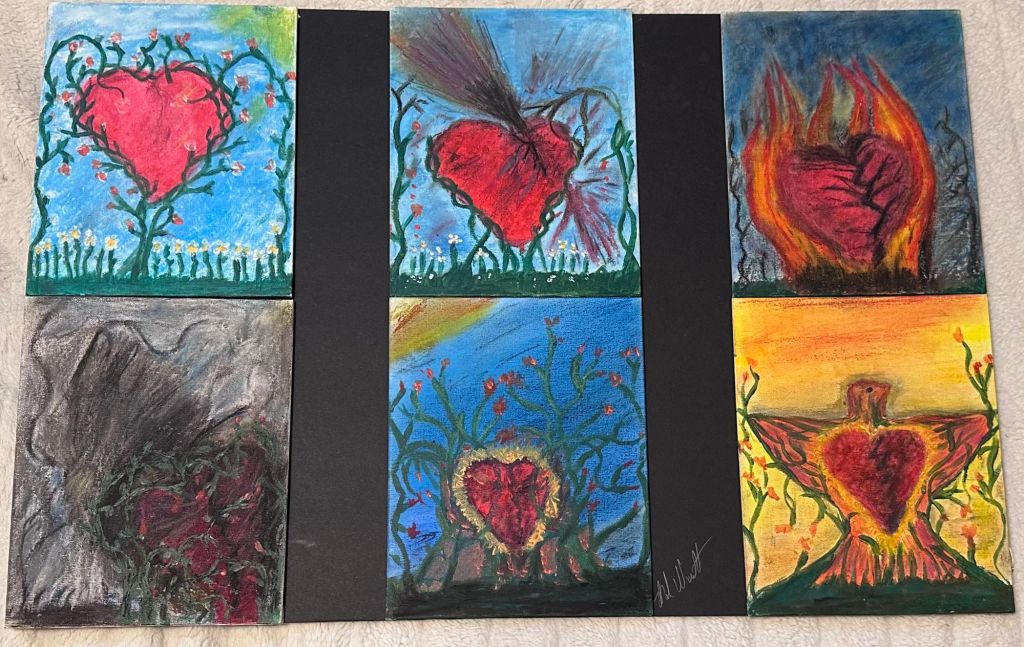
The six hearts came before I understood why there had to be six.

Because how does one heart describe how a beautiful life that once held longing, hope, purpose, and possibility became a battlefield of destruction that no one else could see?

The damage was not visible in my physical appearance, yet internally, I was being torn apart.

One heart could not tell that story. The damage itself could not either. It became a festering wound that tried to kill me slowly enough that even I could barely notice.


The first heart is colorful, vibrant, pure.

It has fine, small, intertwined vines—nothing sharp, nothing controlling. They are simply part of it.

There is an abundance of light. Innocence, love, and happiness without question or delay. Hope grows everywhere. Growth is made of a world of possibilities.

The heart does not question itself. It does not brace for anything. It simply exists.

Safety is natural, normal—a given.

There is an innocent longing.

Hope.

Purpose.

Possibility.

The belief in a happy ending is natural, even when life is difficult. There are dreams that something beautiful is ahead.


The second heart is where life begins to change.

The darkness moves in ever so slowly.

The thorns take root and grow stronger as they thrive on darkness. The painful thorns begin wrapping around the heart, just a little at first.

Not enough to panic.

Not enough to fully understand.

Simply enough to know something is different.

Something is wrong.

The darkness begins moving in. It does not crowd out hope or love, but the heart begins questioning its existence because the thorns have slowly caused pain. The darkness creates force fields and safeguards to protect the heart.

The darkness does not take everything.

There is still light.

There is still a recognizable version of the life that existed before.

But now there is awareness.

Caution.

The darkness begins to numb the senses because love is starting to become painful and frightening.

And this awareness changes everything.


The third heart is the beginning of the end.

Not breaking.

Not shattering.

Melting.

The pain becomes unbearable, far too intense to maintain a grip on hope.

The colors begin to run. The edges no longer hold their shape. The thorns tighten, and the darkness spreads farther across the heart.

There is still something that resembles the mind that once was, but the darkness begins to win, and the heart begins to burn. The darkness no longer controls only itself; it conquers the light as well, nearly burning everything to the ground.

The mind no longer knows how to hold itself together, and with it, the heart begins to be consumed.

This is the part people do not always understand.

A person can still look like themselves while everything inside their mind is collapsing.

Still go to work.

Still answer questions.

Still solve problems.

Still smile when someone speaks and engages them.

They can still be the caregiver.

Still perform the tasks required of an ordinary life.

And all the while, their heart is melting beneath the burning mind, hidden beneath the smiling mask.


The fourth heart is almost entirely consumed by a  feelingless numb existence.

It is almost entirely dark.

There is very little hope.

The pain is too great.

Happiness has left.

The heart has allowed so much darkness to enter the mind that the vines are now a circle of thorns, which have nearly swallowed the heart completely. Almost all hope is lost, and the wounds are deep. The mind does not want the heart to be visible. It allows the darkness to surround it.

Yet this is not sadness.

It is something deeper.

The person you once were becomes so distant that the realization sets in, and you begin to wonder whether you ever existed in any version you knew.

There is no clear beginning or ending to the pain anymore.

No clean line between the heart and the darkness of the mind.

Only survival.

Only the smallest remaining spark of the mind, a piece still beating in the heart beneath everything that tried to bury it.

This is the battlefield no one sees.

The one no one should ever have to imagine or experience.

Yet from the outside, no one looks into your eyes and sees the black hole of numbing existence you have fallen into.

From the outside, they believe you are fine.

Sometimes you keep the mask on because even you want to pretend to believe that you are happy.

There may be no blood.

No broken bones.

No visible wound.

Nothing concrete that the world can validate.

Only numbness for the heart and emptiness for the mind.

Inside, everything familiar has been destroyed.

Safety.

Trust.

Identity.

Hope.

The ability to believe your own body when it tells you that you are safe becomes impossible.

This creates the worst wound because somehow, you are still expected to walk through the world as though nothing happened.


Only the fifth heart has some ability to allow hopes light to begin to return.

This occurs by sheer force of will.

A desire to see another sunrise.

A belief that the small spark of sunrise—of hope—is truly a reality and not some sort of cosmic joke.

But the light does not defeat the darkness immediately.

It is a slow, painful process, and it does not occur all at once.

It isn’t dramatic.

Only a very small section of purpose opens.

A sliver of color, light, warmth, and meaning.

The mind becomes a place where the darkness no longer owns everything.

But the heart grows back slowly and smaller. Sometimes a different shape or purpose is the only way growth can begin.

Flowers begin growing around the thorns again—the ones allowed this time around, the ones chosen to help growth have meaning again.

The thorns have not disappeared.

They are evidence that the mind grew differently, more cautiously.

The flowers grow beside the thorns, not to reflect the pain they created, but in spite of them altogether.

The heart is not restored to what it was before.

The mind changed it forever.

Instead, it is becoming something else.

Something better, more relentless, and far more resilient.

Something both wounded and living at the same time.

Fear still exists.

So does grief.

Along with all the memories as proof of existence.

Some days, the darkness still feels closer than anyone wants.

But growth has also brought other things.

Understanding.

Voice.

Connection.

Truth.

And perhaps most importantly, the realization that survival was never supposed to be the end of the story.


The final version of the heart has grown into something extraordinary.

The mind finally realizes it could never return to the version of the heart that existed at the beginning.

Instead, it had to grow into something new.

The untouched light of the first heart is gone.

The mind is different because the first heart believed in possibility without ever having learned darkness or fear.

The final version of the heart believes in possibility because it survived what tried to destroy it.

It also understands that survival is not the same as healing.

Healing does not erase the pain or make it as though it never happened.

The heart carries every stage that came before it.

The darkness was fought against for long enough and hard enough that the heart learned something it did not know before:

Darkness can exist without being allowed to own everything.

The heart begins to live more deeply and more colorfully.

The flowers open again.

The thorns that remain are woven into the landscape by deliberate design. They are not hidden or denied, but they are no longer allowed to decide what grows there.

That is the difference.

Before, life simply happened around the heart.

Now the heart chooses.

What it protects.

What it allows near it.

What it feeds.

What it lets grow.

The darkness did not disappear.

Neither did the memories.

They became part of the landscape instead of the entire horizon.

The heart is no longer melting.

It has found its shape again.

Not the same shape.

Its own shape.

The shape it created after discovering that healing was never going to mean becoming the person who existed before the battlefield.

Growth comes from knowing that the past does not have to be exposed for everything to see, nor does it have to be hidden away as though it never existed.

The past becomes knowledge.

And that knowledge gives hope something it never possessed before:

Information.

The heart now knows there will always be darkness somewhere in the world.

It knows safety can disappear quickly.

So the heart guards itself differently now.

It remembers grief.

Fear.

Numbness.

Complete emptiness.

It does not have the ability to forget what those things felt like.

Yet it still chooses to believe there can be something beautiful ahead.

It fights for growth.

It learns again that there is a world of possibilities.

But because of everything it has been through, it understands something the first heart never had to understand:

Possibility is no longer assumed.

It has to be chosen.

The heart cannot erase the devastation the mind endured during its fight on the battlefield.

But it can allow itself to grow beyond it.

It no longer hides its broken pieces from the world.

It wears them as evidence that it survived.

The scars do not have to be discarded or covered because harm is not something that simply disappears when it is locked away.

Given the right light, the right sun, and the right direction, even the places shaped by pain can become part of something living.

The heart gets to decide what remains.

Some thorns become boundaries.

Some are no longer given space.

Some of what once represented pain becomes evidence of growth.

And none of it has to be carried with shame.

The broken pieces are not proof that the heart became less beautiful.

They became part of something far more beautiful than it ever imagined it could become.

This is why the heart allows flowers to grow again.

Because this time, it wants them there.

The flowers are not accidental.

Neither is the light.

They are chosen.

The heart allows the mind to build around the thorns without pretending they never existed.

It decides which ones remain as boundaries and which ones no longer deserve space.

The flowers grow because they are wanted there.

The light exists because the heart fought long enough to find it again.

This heart is not evidence that I returned to who I was.

It is evidence that I became someone I could not have imagined before.

Not untouched.

Not without scars.

Not without darkness.

But alive.

Aware.

Choosing.

Growing.

Becoming mine.

Maybe that is why there had to be six.

One heart could have shown pain.

One heart could have shown recovery.

But one heart could never have shown the entire war.

The innocence.

The warning.

The collapse.

The disappearance.

The return.

The becoming.

For so long, I looked at what happened to me as evidence that something inside me was defective.

I saw the panic.

The anger.

The confusion.

The exhaustion.

The hypervigilance.

The pieces of myself I could no longer reach.

And I blamed the heart for what had wrapped itself around it.

But I am not the villain of this story.

I am not the darkness.

I am not the thorns.

I am the heart that remained beneath them.

And I am still becoming.

The Grain Beneath


So as I was working on an old door today—a vintage door, I’m not sure how old it is, but it looks like it was probably an exterior door with a single pane of glass in the middle—it hit me.

It’s one of those things I bought because I knew I would do something with it someday.
And then everything happened.

Now it has become one more project that sat too long—whether from procrastination, exhaustion, trauma, or simply life getting in the way.
And maybe that’s me too.

I don’t feel very yellow brick road right now.

And the sad part is, I had so many good words in me today.

Most people look at things as disposable. At least in today’s world, that’s what it feels like anyway.

There are a lot of people who would ask themselves, what’s the point in fighting for something that has three layers of paint on it when it would be easier to simply replace it?

Maybe that’s part of why I see the world with rose-colored glasses.

But I guess the thing people misunderstand about rose-colored glasses is that it doesn’t mean you think everything is always beautiful.

Sometimes it simply means you can still see beauty in something after it has been neglected.

Because that door has a story.
Just like any of us do.

Whether it’s a person or a thing, from the moment we are born—or built—everything begins to shape us into what we become.

As I worked on this door, I used two containers of paint remover. The battery kept dying on my electric sander. The sandpaper was too fine and couldn’t get down into the deeper grooves.

And the weathered side of that door—the side that had taken the beating—held onto that paint like it had fused into its DNA.

No matter how much stripper I put on it, that paint was ingrained.

At least the top layer was easily removable, and didn’t put up a fight. That of course was just the visible superficial layer, that layer that the world sees without having to dig too deep or as too many questions.

And somewhere in the middle of removing the visual easy superficial paint, I started to see myself.

There were layers and layers of difficult, complicated things that had attached themselves to me over time.

Things that harmed me.

Things that changed the way I move through the world.

Things my own mind still struggles to fully comprehend sometimes.

And over time, it made me feel weathered too.

Worn.

Like life had sat on me a little too long.

And I guess I began to realize that the final layer—that deep-seated, rooted, hard-to-remove layer of paint—was the part of me that feels like the trauma of the last couple of years.

Because the more I worked on that door, the more I could see the beauty underneath it.

The grain.

The movement.

The oak waving through in places where the paint finally gave up.

And what struck me was that those lines weren’t man-made.

They were created by nature.

They were the backbone of that door.

Its original structure.

Its truth.

At one point, it was a living thing until it was cut down and turned into something meant to become useful—maybe even beautiful—to someone else.

And that made me think about how healing from complex post-traumatic stress disorder—complex PTSD—is not simple.

Complex PTSD can develop through repeated or prolonged trauma, where painful experiences layer themselves into the mind and body over time.

It is not one event.

It is not one wound.

It is not one memory.

Every layer you remove exposes another layer underneath it.

And just like I fought to get the paint off that door, I fight to understand what caused all of it underneath me.

Why I react the way I do.

Why certain things still live in my body.

Why some pain is surface-level and some pain feels like it has soaked so far in that you don’t know if it can ever fully be stripped away.

Now the average human—and I don’t say that with disrespect—would say enough is enough.
They would have thrown the door away.

I fought with that door for five days, and I’m still not done.
And it still needs repair.

But then again…
I’d say that about me too.
And maybe that’s the point.

Maybe the point isn’t that it should have been easy.

Maybe the point isn’t whether it would be cheaper, faster, or more practical to replace it.

Maybe the point is that some things still deserve to be saved.

Not because they are perfect.

Not because they are convenient.

Not because they haven’t been damaged.

But because underneath all the layers, there is still something solid there.

Still something real.

Still something worth bringing back to life.

As I continued to sand the door, I noticed something else.

The layers of damage were deepest in the most delicate parts of it—the places with the most detail, the places that had the most exposure to the harshness of the world.

And I realized I had come to a crossroads:

Do I repair it until it looks like new?

Or do I sand it and allow the finished product to still carry evidence of what time and neglect had done?

That question hit me harder than I expected.

Because I realized that in me, too, every layer exposed through this journey has left jagged places and missing pieces—things a Band-Aid could never simply cover.

As I looked at that door, I saw the pitted sections.

The softened places.

The rotten wounds.

And I realized that with grace, time, and just the right amount of pressure, even damaged things can still become something.

I think my complex PTSD was shaped, in part, by all the years I never allowed myself the time to heal.

I always rushed.

I, like that door, spent so much of my life shielding others from the harsh elements that I never stopped long enough to deal with what all of it was doing to me.

I tried too fast and too hard to get over things.

To be fine.
To function.
To keep going.

They are there as proof.

To pretend the weather had not reached all the way in.


But this time, just like that door—the one that had been discarded as useless, too far gone, too much of a burden to repair—I finally see something different.

The scars are not proof that it is ruined.

They are evidence that it made it through the storm.

I also realized, while working on that door, that some of the wood had been too weathered to survive.

As I sanded, parts of the rotted edges came away.

And that made me think about something I had not fully put into words before:

Was the goal to make it look new again?

To repair it so completely that someone else would never know the original damage had ever occurred?

At first, that feels like the right answer.

But the more I thought about it, the more I realized that doing that would also remove the real story.

The real truth.

Because nothing once damaged is ever truly new again.

And maybe that is not failure.
Maybe that is simply reality.

Maybe beauty was never supposed to come from pretending the storm never happened.

Maybe beauty comes from surviving it.

Not by announcing every scar.

Not by turning every wound into an identity.

Not by using pain as a shield of protection the way I once did.
But by understanding that the scars are not there to make me harder.

Proof that I still exist in spite of the harsh elements that once tried to wear me down.
And maybe the most sacred realization of all is this:

That on the inside, the softer parts of me—

the healthy parts,

the loving parts,

the hopeful parts,

the parts that still wanted beauty, connection, gentleness, and peace—
those were the parts worth protecting all along.

Not the armor.

Not the survival mode.

Not the shell.

The softness.

The softness was never a weakness.

It was the part of me that survived.

And maybe healing is not about pretending the weather never touched you.

Maybe it’s about stripping away what was never supposed to stay on you in the first place.

Maybe it’s about realizing that the deepest parts of who you are were never the damage.

They were always the grain.

They were always the oak.

They were always the part that remained after everything else started coming off.

And maybe that’s why I keep fighting with old doors.

Maybe that’s why I keep fighting with myself.

Because somewhere underneath the exhaustion, the fear, the anger, the grief, the years of surviving, the shutting down, the hypervigilance, the overthinking, the numbness, and the scars…

I know there is still something beautiful under there.

Not untouched.

Not unbroken.

But beautiful all the same.
And maybe the world would call it too much work.

But I don’t.

Because I know what it means to look at something weathered and still see its worth.

And maybe that’s why I keep going.

Because I am not disposable either.

The Way My Mind Remembers :  Trauma, Memory, and the Pain of Healing


People have often asked me how it is that I’m able to remember so many details.


The truth is, I don’t remember quite as well as I once did. A lifetime of incredibly difficult and unusual circumstances, wrapped up in the word trauma, changed the way my mind holds onto things.


Trauma has a way of affecting even someone who once could catalog everything in their mind down to the smallest detail.


That does not make me extraordinarily brilliant.


Quite the contrary.


I learned that much of my ability to remember came from my life circumstances. Somewhere along the way, remembering became one of the most important parts of me.


Maybe it came from what life threw at me.


Maybe it came from something much simpler.


I never wanted to be forgotten.


Maybe that is part of why I learned to remember so much. I remembered the details of people—their words, their faces, the things that mattered to them—because remembering felt important.


If I remembered you, you mattered. And somewhere inside me,  I wanted to know that I mattered enough to be remembered too.


Remembering was also a defense mechanism because I never wanted to allow myself to become trapped, questioned, or ridiculed in a harmful situation again.


It is hard to explain what it feels like to have a mind shaped by trauma while trying to work through it, heal from it, and explain to others how deeply life’s experiences can become ingrained—so deeply that they are physically felt too.


I can often remember the sounds from an event—the flashes of light, the temperature—before I remember the words in the conversation.


I can remember the feeling in my chest before I remember the words someone spoke to me.


I can remember how the light shined.


I can remember their faces as they walked out of the room.


And sometimes I can still almost see the silence—the cold shoulder, the lack of empathy or care, the way someone can throw silence at you.


Maybe this is simply one of the skills a trauma survivor develops.


I can remember the weight of each moment as though my nervous system were keeping its own journal, a record of both positive and negative memories.


Other people may be able to remember joy simply as happiness. I often feel as though I remember all of it—the joy, the fear, the atmosphere, the weight of the moment—as though my nervous system is always keeping score because it never completely rests.


Maybe that is because I don’t simply remember what happened.

I experience it over and over again.


There is another part that has always been difficult to explain, and sometimes it can make you feel incredibly alone.

What can feel like a trauma survivor’s superpower is the nervous system’s ability to brace and sense, with every fiber of your being, the potential danger that may be around you.


Is that why, when I see memories, it feels as though I’m watching a movie from the outside?

Watching every scene of that memory, whether it is positive or negative?


Is that why I need to remember the whole thing?


But remembering everything is painful—the bad and the good.


Maybe that is part of why surviving trauma can feel so lonely. Life itself can become a painful, constantly on-guard experience.


It is hard to explain how you can see yourself standing somewhere and know what is about to happen. As you watch every moment unfolding in the past, you wish you could reach through the screen of your mind and change the ending.


I can’t.


No one who has survived incredibly difficult and complicated circumstances, all wrapped up in the word trauma, and made it to the other side can reach backward and change what happened.


Even though every fiber of your being can make it feel as though it is happening again, the movie always plays the same way.


For many years, I wondered if something was wrong with me because my memories felt different.
My descriptions felt deeper.


My words seemed to touch people as I told them the complicated stories of life with a passion that made them want to hear more.


I suppose it is only now that I understand that this is simply the way my mind learned to survive something overwhelmingly painful.


It is through this realization that I have changed the way I look at myself.


I no longer judge myself because a sound makes my heart race or because a memory arrives carrying the same physical sensations it carried the first time around.


I understand now that my body was paying attention even when my mind was desperately trying to survive.


Maybe that is why I remember so much.
My memories were never stored only as stories.
They were stored as sounds.


As sensations.


As images.


As fear.


As silence.


And remembering is painful whether the memory is bad or good.


Maybe this is what defines trauma healing and why it is so painful, because the pain is what stops or stalls the healing process.


So for now, I write these stories not because I could change anything when those things happened, but because I am no longer trapped as the woman inside those scenes.


Now I am also the woman watching—and healing in the process.


My hope is that, as you read these stories, you see yourself not in my incredibly difficult circumstances or trauma, but as the individual trying to change your own scene, grow, and heal outside of the trauma that has defined so much of your life.


Maybe healing is learning that trauma can be part of your story without being the only thing that defines you.