
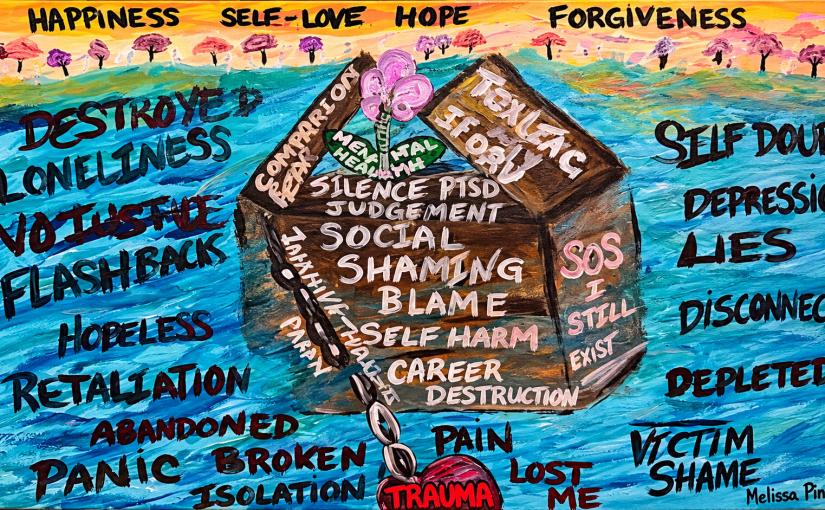
For Whoever Needs This
If you are reading this because something inside you hurts, I want you to know something.
Maybe the noise won’t stop. Maybe the memories won’t fade. Maybe you are tired of pretending to be okay.
This was not your fault.
You did not deserve it.
And struggling does not make you weak. It means your body fought to keep you alive.
There may not be one cure, one medication, or one answer for all of us. But there is one truth I have learned again and again:
You deserve to be heard long before you feel healed.
If you feel like you’re running a marathon in quicksand, if even the smallest sound makes your heart brace for danger, if you’re afraid that no one will stay beside you when it gets hard, I understand that more than I can ever explain.
Maybe no one can fix you.
Maybe fixing was never the goal.
But please take this with you:
Strength is not never sinking. Strength is refusing to stay buried.
Your voice matters.
Your pain matters.
Your tomorrow matters, even if today hurts.
If nothing else, let these words be proof:
You are not invisible.
I see you.
And I believe you can make it through.
For the Friends and Family of Someone Who Suffers
If you love someone who lives with trauma, you may sometimes feel unsure what to do or be afraid of saying the wrong thing.
You might see them cry without warning.
Pull away when they actually need closeness.
Lash out when they are really just scared.
You may take it personally. You may feel helpless. You may even feel tired too.
Please know this:
They are not choosing their pain.
Their nervous system is reacting for them long before their logic even has a chance to even process the situation.
They are not trying to be difficult.
They are trying to survive.
You don’t need the perfect words.
You don’t need to fix it.
You don’t need all the answers.
Sometimes all they need is:
“I’m here.”
“I don’t fully understand, but I want to support you.”
“You don’t have to carry this alone right now.”
Sometimes the most powerful thing you can do is stay without trying to change them.
Because it’s not about rescuing them.
It’s about not abandoning them while they’re learning how to rescue themselves.
Even with good intentions, some phrases may cause harm:
“You just need to calm down.”
“Can’t you get over it by now?”
“But that happened years ago.”
“You’re too sensitive.”
“Other people have it worse.”
It may seem logical, but trauma doesn’t respond to logic.
It responds to safety.
To compassion.
To patience.
They are not broken.
They are rebuilding.
And they are still learning how to live in a body that remembers what they wish it could forget.
You may never fully understand what they carry. But if you can choose to walk beside them anyway, even when it’s messy, you will give them something that medicine never could:
Proof that they are still worthy of love and care.
That kind of presence is not weakness.
That is courage.
That is love.
And sometimes, that is what helps a survivor make it to tomorrow.
Part I: What CPTSD Really Is
All the years of abuse. All the traumatic instances. All the ways I had to survive financially, physically, mentally, spiritually, and in relationships.
I always had someone to lean on.
A therapist.
A lifeline.
Someone who could remind me that I was still here.
But the funny irony is this:
The week before it happened, the last time, the one I swore would never happen again, my therapist and I had just spoken.
We talked about how far I had come.
The night of the assault, I called her. I needed her, I knew I was not okay.
She said, “Oh my God, Melissa. You had come so far. You can get through this. You’re strong enough.”
I didn’t want pity.
I didn’t want advice.
I just needed someone to hear me.
As the weeks went on, it was my voice, not her answers, that saved my life.
Just telling someone, anyone, was enough to keep me from the unspeakable end of my existence.
They didn’t need to hear every detail.
They just needed to listen.
But ironically, that also became my downfall.
It was my voice that made someone uncomfortable.
It was my voice that triggered a complaint.
It was my voice they said talked about sex too much.
It was my voice that shattered the silence they depended on.
And my voice, once again, brought back the ugly history of my supervisor, somebody who had already tried to take my worth from me.
That is another chapter.
The nuclear bomb.
The one I haven’t fully written yet.
But when I was diagnosed with Complex Post-Traumatic Stress Disorder, everything suddenly made more sense.
And hurt more deeply.
We hear PTSD and we think of soldiers. The ones who come home from war and fear loud noises, sudden movement, fireworks in July.
We think of police officers and firefighters. People who see one horrific moment they can’t forget.
But some of us didn’t witness one moment.
We lived it on a constant basis.
We weren’t on a battlefield.
We were the battlefield.
That’s what people don’t understand about someone like me.
CPTSD is what happens when survival becomes your identity.
It’s when the people who were supposed to keep you safe became the reason you question if you deserve safety at all.
Here is what my war looked like:
A childhood with no positive reflection. No one to say, you’re good just as you are.
The loss of a father at six years old.
A mother who tried, but carried her own storms. Was a widow at 25 with a six year old and 3 year old who suddenly had to become all the things it takes to raise children, keep a house and do it all alone.
The joke about my first kiss that shattered my sense of worth.
A teenage boy who took advantage of my innocence.
Domestic violence wrapped up as love from boyfriends.
Black eyes.
Concussions.
A choice no woman should ever have to make about her own body.
A custody battle to protect my child.
A medical fight to save my daughter life from Type 1 diabetes every single day.
A marriage where I became the protector, the provider, the one who held everything together.
And finally, the detonator.
Sexual assault and entrapment.
And that became the breaking point, creating the flame and the point of no return.
Followed with discrimination for being a victim by a state agency that exists to protect people like me.
That was the moment the war inside me finally said:
ENOUGH!!!!!
Part II: The Search for Relief
Once you obtain a diagnosis, you begin the next battle:
Trying to find anything that will ease the pain.
You bring the diagnosis to doctors.
To psychiatrists.
You hope that naming it will help fix it.
But naming it is only the beginning.
I was never formally 5150’d or institutionalized, but I’m not going to lie.
There were days when the thought crept in.
Days when I spoke to the professionals who cared for me and said:
“I don’t know how much longer I can keep going like this.”
You find good providers.
You try to find people who care.
You try every medication.
You go through the giant list of antidepressants, every pill that promises relief.
But nothing touches the pain in your mind.
Nothing eases the ache in your bones.
Nothing makes you feel like you again.
When you are deep in the throes of Complex PTSD, you start to forget who “you” even is.
And when you’re also ADHD, your PTSD becomes like the Incredible Hulk climbing the stairs of your nervous system.
You see your psychiatrist every month.
You try one drug after the other.
And at some point, you realize that they know something too.
You may never fully get better.
Not because you don’t want to, but because something new keeps being thrown at you before your body ever gets the chance to heal what came before.
You call hotlines.
You call 988.
You call your advocates at the Rape Crisis Center.
Your friends try.
God knows they try.
But after a while, you start to feel like a burden.
You try to explain it to your family when it’s Christmas.
But something as simple as a normal conversation sends your mind into a tailspin where the only thing that keeps you grounded is lining up colored tiles on a phone screen.
Because if you don’t, you might scream.
And everyone might finally see the demon that trauma and CPTSD has carved into your nervous system.
Part III: When the Treatments Aren’t Enough
When the diagnosis comes, you expect some kind of relief.
But sometimes the diagnosis just opens a door, and behind that door is another kind of exhaustion.
You try ketamine.
You get prescribed rounds of Transcranial Magnetic Stimulation.
Thirty-eight visits.
Nearly thirty-eight days in a row.
Because maybe, just maybe, it will help you breathe again.
The medications don’t work.
Sleep disappears.
And it doesn’t make you weaker, but it makes it impossible to recognize yourself.
In my case, I learned something important:
I didn’t just have trauma.
My trauma got worse after I was discriminated against for being a trauma survivor.
That’s when the closet came.
That’s when I was boxed in a storage room nine hours a day, listening to noise after noise, conversation after conversation, wondering how no one could see I was drowning right in front of them.
I wanted to scream:
Can’t you see me?
Can’t you hear me?
Can’t you feel my pain?
Didn’t you see me vomit in the parking lot?
Didn’t you see the look on my face when I begged to be heard?
But when you have Complex PTSD, you learn something.
No medication stops your mind from convincing itself that it is still in danger.
In my case, even the hum of an aquarium feels like a threat.
A fan running can take away my sleep.
I don’t rest.
I brace.
I don’t hear sound.
I hear warning.
And if anyone were to ask me, how did you survive this?
I would tell them the truth:
My only other option was six feet deep.
That’s the reality no one talks about.
Trauma healing is not a sprint.
It’s a marathon.
And when you have CPTSD, it’s a marathon through quicksand.
What I want the world to understand is this:
I don’t need to be babied.
I don’t need to be treated as fragile.
I just need compassion instead of judgment.
Someone to say:
“I see you. I don’t know what you’re going through. But I care about you.”
It took two years for my family to begin to understand.
My own mother once said, “You need to get over this PTSD shit.”
And then, at a football game, I watched her yell at children for blowing a horn because she knew I couldn’t handle the sound.
Even my ex-husband stepped in one day and said:
“Someone hurt her really badly. Could you please be careful? That’s PTSD.”
It’s not that I need protection.
But someone did hurt me.
The psychiatrist tried.
The medication failed.
And ultimately, it was my voice, my art, and my truth that kept me from disappearing.
Because once the detonator goes off, you will never again be the same person you were before it.
But if you face it, if you use whatever healing you can find, you might come out stronger than you ever were before.
For me, that healing is art.
It is speaking my truth.
It is becoming unboxed.
Part IV: What Strength Really Is
There is no one thing that can fix us all.
No single cure.
No magic word.
No miracle pill.
But there is one thing I have learned, and it might be the only universal truth trauma survivors share:
It was not our fault.
We did not deserve this.
We deserve to be heard.
We did not deserve to be hurt by someone else.
And it is okay to not be okay.
Sometimes daily.
I didn’t get through this alone.
I had medical providers who begged five times for accommodations from the employer who discriminated against me.
They cried with me.
They stood beside me at art exhibits.
They watched me get angry with them and still came back.
That is support.
And sometimes the hardest part is not facing your trauma.
It is apologizing to your children for the moments you lashed out.
Not because you were angry at them, but because the world had been cruel to you and your body didn’t know where else to release the pain.
That is the hardest thing to admit:
This wasn’t their fault either.
So I take it one day at a time.
Sometimes one moment at a time.
Tomorrow I might not be okay.
That doesn’t mean today was a failure.
I cry daily over the tricks my mind plays on me.
Over the feeling that I have lost everyone who once cared.
But there is one thing I hold onto:
The change I make for myself because of what happened to me might become the reason someone else chooses to live.
Maybe that is all I can do.
Maybe that is enough.
People say “you are not alone,” but that is not always true.
Very few people will sit in the quicksand with you and hold your hand while you try to breathe.
But strength isn’t about never sinking.
It’s about refusing to stay buried.
And if I keep using my voice, maybe someone, somewhere, will keep using theirs too.
That is the art of healing.
That is becoming unboxed.

