
Friday Night Lights


Friday Night High school Football

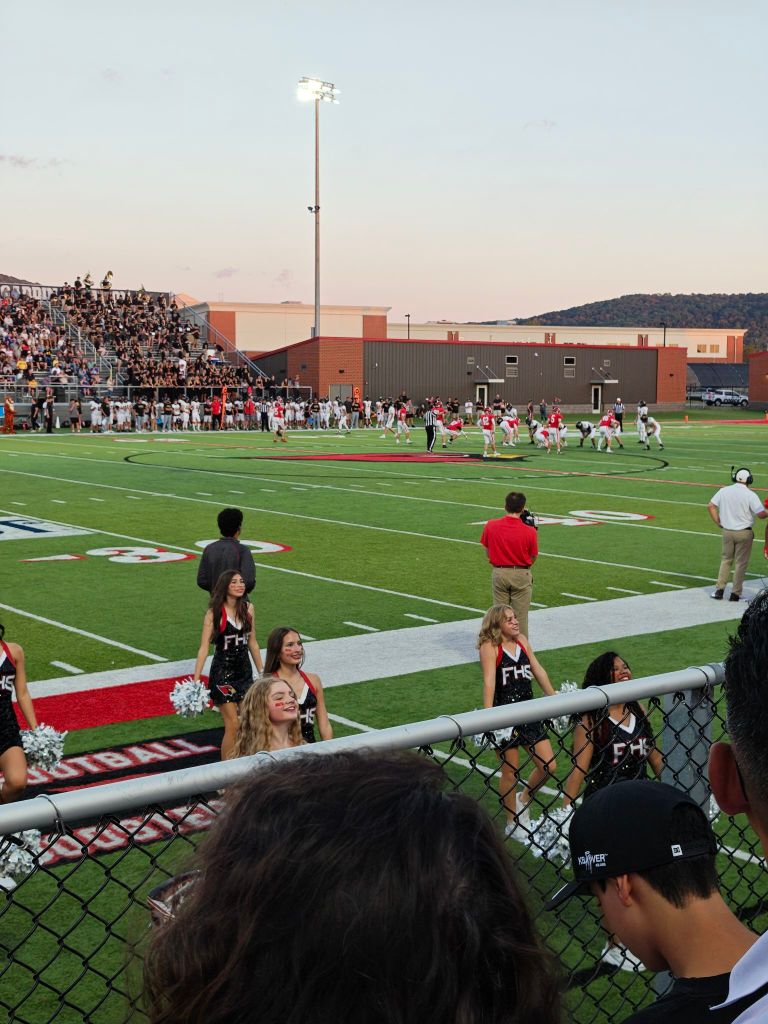
I am here to support my son and his team on a beautiful fall evening. It feels almost surreal that nearly a year ago today, I could sit in these stands without trembling. Back then, I could feel the thud of the players’ feet, the sway of the bleachers, the contagious energy of youth—and still breathe without flinching.

I didn’t know then how sacred that internal calm had been. Back then, I just stayed somewhat numb to avoid the pain.

Now, every sound has a sharp edge. Every rhythm has a painful point my body still doesn’t know how to process it. The air hums with a tension that is somewhat unexplainable. A child keeps blowing a moose horn. I am sure they probably mean for it to distract the other team. Unfortunately for me, each blast feels like it’s aimed straight at my nervous system.

The Farmington High School Cardinals’ home field glows under the Friday night lights. In celebration of every touchdown, fireworks split the dark Ozark sky. They’re breathtaking against the untouched hills that form the backdrop of the stadium. The gentle rolling hills, full of natural beauty, still hide the stadium from the glare of city lights.

Yet for me, every explosion feels like an assault on my senses.

Gabe is a junior and not the starter. This is okay, because time moves like the blink of an eye. This is his last season as the low man on the totem pole. A place almost every adult who has played a sport remembers. With eight minutes left in the second quarter, our team is winning.

It is one of those moments when, as a parent, you find yourself hoping: Maybe he’ll get a chance to play but also realizing that this is someone else’s last season to shine.

After COVID, he found his love for football. When he was little, his autism made sports hard. We tried soccer and baseball. Instead of watching the batter, he would pick flowers in the outfield. Instead of kicking the soccer ball, he would follow the butterfly and go the other way.

So for him to thrive in football last year was incredible. I got to watch him come alive on the field. I got to watch my son find something that lit him up.

That was the first fall after the assault. I was already hypervigilant, but I could still gently calm myself enough to enjoy the energy of the crowd.

Then my employer force-transferred me into a confined, dark, cold closet.

After that, I developed a new kind of fear: agoraphobia.

Now I hear everything.

Every whisper. Every scrape. Every creak.

My ears became too alive, my body too aware. Even now, the faintest sound—a water bottle crinkling, a pen clicking—can feel like a warning:

Danger is near.
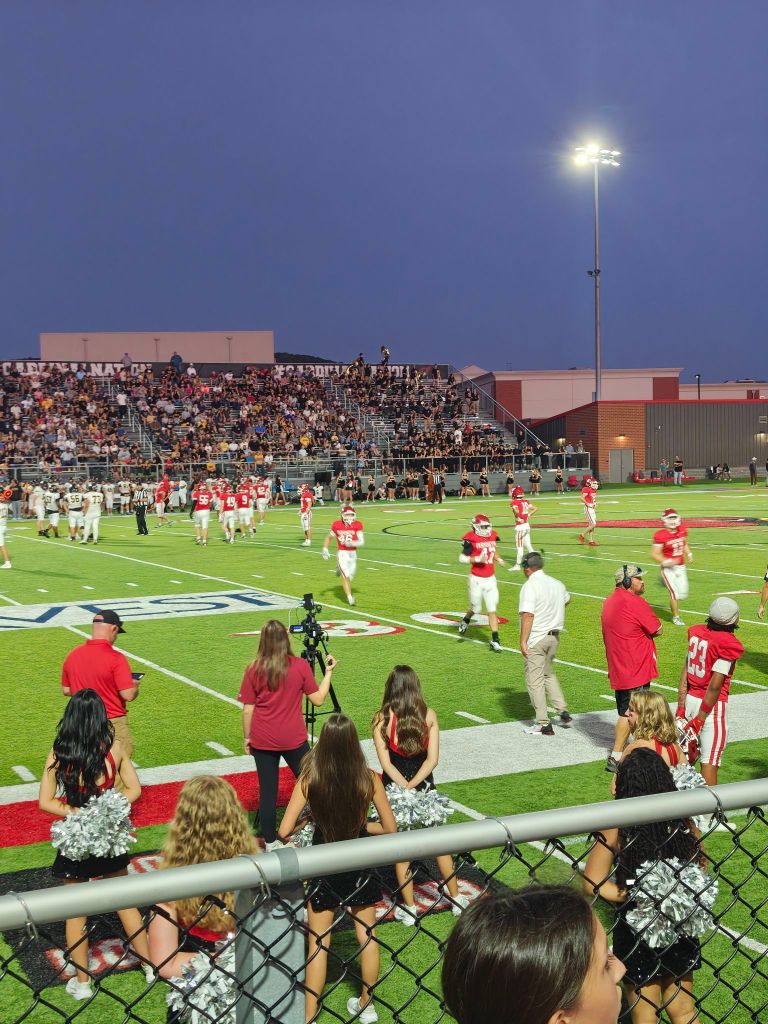
Friday night lights Farmington Cardinal Statium


Every touchdown brings another firework, another surge of beauty and panic intertwined. I watch colors bloom across the dark horizon, and I flinch anyway. The crowd cheers, and then the announcer plays “Kickstart My Heart.”

That song came out when I was in high school—when the world still felt wide open and loud in a good way. Hearing it now makes time fold in on itself, my youth and my son’s overlapping in the glow of the Friday night lights. In my mind, I can almost see the girl I was in those stands, laughing and carefree, unaware of what life would take and what it would teach.

The song’s the same, but I’m not.

Now it hits differently much louder somehow, as if it’s reminding me that my son is growing up inside the same rhythm that once carried me, and I’m fighting to stay steady enough to witness it.

My heart won’t stop. My mind won’t stop.

It feels like fighting a mental battle with the cancer of my memories—something that grows inside me without permission, spreading through nerves and thoughts alike. Surviving it feels like chemotherapy for the soul: exhausting, brutal, but necessary if I ever want to live again.

I look out onto the field and notice a girl with green cat-ear headphones snapping pictures of the team. I assume they are for the yearbook. Even though her ears are adorably covered, I notice that she, too, flinches when the fireworks burst.

I wonder if maybe she understands, or maybe she’s simply doing her job. Somehow, the reason doesn’t matter. Noticing her reaction steadies me. It reminds me that I may not be the only one enduring the noise in order to capture something that matters.

When the crowd gets too loud, I retreat to the concession stand and then find myself slipping beneath the bleachers to hide my tears from the world.

I know I am here because I love my son. I also refuse to let fear win.

Mind you, I know every part of me wants to go home. But I choose to stay, even while trembling, breathing too fast, and sick to my stomach. I remind myself that this moment matters.

Fighting through it matters.

Making moments become larger than pain matters.

I know trauma isn’t invisible; it’s physical. The symptoms I experience live in my bones, my pulse, in the way every nerve hums with false alarms. I carry it like a chronic illness—the cancer of memory that threatens to consume what’s left of my peace.

But I keep fighting, even if survival looks nothing like healing.

Tonight, I’m not whole. I’m not calm.

But I’m here.

I’m showing up in a place that once felt safe, even though it still hurts to inhabit. That, for now, is enough.

And as I look around, I wonder how many others are missing these moments.

It is not because they don’t care or because they don’t love deeply. I can promise you that is definitely not the case. The reason is much more complicated. Trauma or anxiety is stealing their sense of safety.

Maybe they’re sitting in parked cars outside stadiums or in dark rooms at home, wishing they could be there but unable to bear the noise from the internal alarm system trauma created.

One can only hope that maybe one day showing up won’t feel like survival for anyone who is suffering. Maybe one day the sun will set on our pain long enough for the celebration to feel like living.

Healing must be conducted personally, but suffering should never have to be.

I want others to know they are truly not sitting in the stands alone.

I am right there next to you.

Let’s move toward healing together.

Slowly, but Surely, I Disappeared

People tend to imagine disappearance as dramatic.

A slammed door.
A final goodbye.
A body walking away.

Mine was quieter than that.

Mine happened one toilet flush at a time. One door slam. One scream from the hallway. One sudden laugh behind a wall. One startled jump of my nervous system after another.

Slowly, but surely, I disappeared.

Not physically.

I still showed up to work. I still answered emails. I still attempted to do the job that had been assigned to me without my choosing, for an employer I had spent nearly half my life serving.

From the outside, I was still there.

That was the problem.

By then, internally, my world had already started to shrink. Eventually, that shrinking became both mental and physical.

It was at that point that I found myself sitting inside a room that I would later label “the box.”

But that room was not the first box I had lived inside.

Long before there were four walls suffocating around me, I had trained myself to contain life’s difficulties inside that same, yet metaphorical, box.

Pain went into one corner.

Fear into another.

Memories I could not understand were buried somewhere deeper, covered in cobwebs and dust.

I knew they were there.

A part of me always had.

But the deeper I buried them, the easier it was to remain numb to what had happened.

So they stayed untouched, almost as if they carried their own warning label:

DO NOT OPEN. DANGER.

That numbness allowed me to keep stacking life on top of them.

Work.

Motherhood.

Responsibility.

Education.

Competence.

Humor.

Sheer determination.

Layer after layer, they became the identity that numbness allowed me to build—the version of myself I could live as without disturbing what remained buried underneath.

Internally, as long as those boxes stayed buried in the darkness, outwardly the world believed I could continue to function.

I could work.

I could build things.

I could raise children.

I could solve problems.

I could walk into chaos and somehow become the calmest person in the room.

Looking back now, I believe I treated the pain inside my mind—the things hidden in those dark, frightening shadows—as my own Pandora’s box.

Something you could acknowledge from the outside.

Something you never forgot was there.

But something you did not open.

You did not touch it.

You did not look too closely at what was inside.

Because somewhere inside me was the belief that if that lid ever came off and everything escaped, destruction would follow in its path.

And there would be no putting it all back.

No returning to the person I had been before.

It just so happened that, for a very, very long time, the containment system worked.

Or at least I thought it had.

Then my mind was subjected to a violent crime.

Pandora’s box cracked open, and the darkness I had kept buried for so long began to ever so slightly escape through the very fine hairline crack.

At first, that crack caused what felt like a numb, dazed confusion.

My body did not yet understand that what was surfacing was the reflection of every painful thing I had hidden inside of me.

But the things that had accumulated for years seemed to recognize that this was their chance to surface.

Pandora’s box had been shaken so violently by the actions of two men that the hairline crack could no longer hold.

It split wide open, unleashing the mental wreckage I had spent a lifetime containing and stripping away the numbness that had allowed me to survive it.

Suddenly, the things I had spent so long keeping separate came crashing together in one overwhelming powerhouse of helplessness, attaching themselves to what had just happened.

Old pain with new pain.

Old fear with new fear.

Past trauma with present trauma.

The lid was now fully open, and every fiber of my nervous system felt exposed to the open air around me.

Sounds became warnings.

Closed spaces became different.

Silence felt different.

My own memories began showing up without being invited.

The past stopped behaving like the past.

Everything that had once passed through my world unnoticed now seemed capable of reaching straight inside me.

And at the most important moment—when I needed safety to begin sorting through what I had physically escaped—the walls that had once contained my own Pandora’s box finally crumbled.

Internally, everything was spilling out.

Externally, the walls around me were beginning to close in.

My world became smaller.

My employer removed me from the work, the office, the community, and the personal connections I had known for nearly two and a half decades and placed me in a remodeled storage closet inside a public health clinic.

The room had no windows.

For nine hours a day, for more than nine months, I had virtually no face-to-face human connection.

The room sat directly across from a break room, between two restrooms, and beside a hallway door that constantly slammed.

Children cried as they were being vaccinated.

People talked and held conversations directly outside my doorway.

I constantly heard other doors opening and closing.

And without warning, I would hear the toilets flush so clearly it sometimes sounded as though I were in the room with the person using them.

My office phone barely rang—maybe two or three times a week at most over the course of those nine months.

But there were times when it did ring that I physically jumped out of my seat, as if someone had suddenly walked up behind me and yelled, “Boo.”

To everyone else, these were ordinary sounds in an ordinary building—a busy public health clinic functioning exactly as it was supposed to.

To my nervous system, they were impact after impact.

Sometimes they hit me like firecrackers.

And it was at that point that I began calling the room the box.

There is something painfully ironic about spending a lifetime putting pain into boxes—containing it, confining it, burying it deeply enough that you could continue to function despite a lifetime of traumatic experiences—only to eventually find yourself physically sitting inside one.

It was around this point that I began to understand just how confining that room had become.

For nearly twenty-four years, I had been a field employee. I had never spent my working life confined to an office, much less a windowless room with almost no human connection.

Yet somehow, this was the place my employer had decided was best suited for me.

Because when a person is still breathing, still reporting to work, still answering emails, and still functioning just enough to appear intact, people assume she must be okay.

They see that she can still work.

And if she can still work, perhaps she can perform a new job—one she did not choose, but one someone else decided would better serve the needs of the agency.

No matter how hard I tried to explain it, they did not see what survival was costing me inside that box.

The room itself held reminders of the violent crime I had been subjected to.

The isolation.

The confinement.

The lack of control.

The sudden, unpredictable sounds that reached my body before my mind had time to understand them.

Every day I continued to function inside that room, might have been mistaken for evidence that I was managing.

It was not.

I was simply surviving it.

It was at this point that I asked again for accommodations for the disability created by the violent crime I had survived.

I submitted documentation.

I filled out paperwork.

I explained my triggers.

I tried to articulate what post-traumatic stress disorder actually felt like inside a body that had once been physically trapped and now felt metaphorically trapped all over again.

I thought my words would matter.

I thought following policies and protocols was the responsible thing to do.

I thought providing evidence would matter.

And somewhere deep down, I believed the people in charge would simply understand what was happening inside me.

I believed that if I explained it clearly enough, they might understand that choices I had not made for myself were having consequences they could not see.

That they might reasonably understand that continuing to place me in a loud, unpredictable, confining environment was not helping me recover.

It was making things much, much worse.

So I kept explaining.

And explaining.

And explaining.

Meanwhile, my body kept reacting to what my mind perceived as constant threats.

It was at this point that I began documenting everything—not for anyone else, but for my own sanity.

The notes I took did not look like journal entries.

They looked like surveillance logs.

8:14 — talking in the hallway.

8:15 — door slam.

8:26 — cough.

8:35 — door closes; heart jumps.

8:41 — toilet flush.

8:48 — child cries.

To anyone else, those notes probably looked absurd.

Meaningless.

But to me, they were proof.

Proof that I was not imagining the sounds.

Proof that my body was reacting exactly as I said it was.

Proof that something was happening to me even when no one else could see it.

I wasn’t journaling.

I was recording my nervous system in data form.

Looking back now, I realize that every sound had an internal consequence.

Toilet flush — heart jumps.

Child screams — flash of terror.

Footsteps — body braces.

My muscles would begin tightening before I could tell them not to.

My mind would wander back to the confinement I had experienced at the hands of those two men.

And the longer I remained confined inside that box, the more intense the electrical shocks, panic, and aftereffects became as they moved through my body.

Eventually, everything became reaction first.

Understanding came later.

It was as if my nervous system had become so short-circuited that my brain itself became almost infantile.

I could still speak.

I could still show up.

At times, I could still perform enough of a job to appear functional from the outside.

But there were also moments when I could not complete the simplest things.

I could not put a box together even with instructions in front of me and someone assisting me.

That was how far away I had become from the woman who had spent her life building things, solving problems, and figuring things out on her own.

It was not that the knowledge had disappeared.

I simply could not reach it.

My body reacted first, and my thinking brain seemed to arrive sometime later.

The worst part was that eventually it was not even the noise itself.

It was anticipating the noise.

Anticipation became its own trauma.

I would sit there knowing another door would eventually slam.

Another toilet would flush.

Another child would scream.

Someone would hold yet another conversation directly outside my doorway.

I knew it was coming.

I just never knew when.

So even in the quiet, my body was waiting for the next impact.

Hypervigilance is a brutal way of teaching your body to live—in constant, never-ending prediction.

How to scan for danger.

How to brace for the unknown.

How to prepare for the next thing because danger begins to feel as though it is always waiting right behind the last one.

Hypervigilance sounds clinical.

Living inside it is not.

It is exhausting.

It drains the life right out of you and slowly teaches your body that everything might be the next threat.

Your body becomes its own alarm system, except eventually it no longer knows when it is allowed to turn itself off.

Unfortunately for me, the longer I stayed activated, the less of myself there seemed to be left for me to reach.

First it was my concentration.

Then my motivation.

Then whatever confidence I still had left in my own abilities.

Things that had once been automatic became difficult.

Remembering which direction I needed to go.

What day of the week it was.

Which way was left and which way was right.

There were probably days when I barely knew which leg to put into my pants first.

Every decision became harder.

My ability to communicate changed.

My ability to reason changed.

My ability to simply hold a logical conversation changed.

I had a master’s degree in negotiation, conflict resolution, and peacebuilding, yet there were moments when I could barely figure out which way was left and which way was right.

My ability to organize information completely changed.

I knew the knowledge was still there.

I knew I still had a lifetime of experience.

But somehow it felt as though there were layers between me and the part of my brain where all of it lived.

Looking back now, I realize I was not losing my intelligence.

I had lost access to myself.

And somewhere in all of that, my body was still trying to do the one thing it had learned to do so well—stay numb enough to survive the constant hypervigilance and perceived threats around me.

That is a difficult distinction to explain unless you are the one living inside it.

Eventually, even the version of myself I had trusted for decades—the competent one, the strong one, the woman who could walk into chaos and figure out what needed to be done—all but disappeared.

I had gone from being the person other people looked to for answers to sometimes needing someone to hold my hand and tell me what I needed to do that day.

In my place was someone who tracked toilet flushes to prove she wasn’t losing her mind.

I wrote words in notebooks that still break my heart.

I don’t feel normal.

I don’t know who I am anymore.

Trauma does not only hurt.

It has the ability to alter your identity.

It was at this point that I realized I was no longer only grieving what had happened to me.

I was grieving who I used to be.

And the cruelest part was that I was disappearing in plain sight.

People passed my doorway.

They laughed.

They talked.

They went about their ordinary lives.

Meanwhile, inside that room, my nervous system was fighting a silent war no one could hear—and one that some of the people making decisions about my work seemed unable to understand.

Because you can answer emails while falling apart.

You can sound professional while your heart is pounding.

You can continue working while struggling to remember who you were before survival consumed so much of your brain.

You can appear functional while losing pieces of yourself every single day.

That is the part I don’t think people understand about the darkness.

Darkness does not always arrive all at once.

In my case, it accumulated.

One experience attached itself to the next.

One memory awakened another.

One frightened response taught my body to expect that the next one was just around the corner.

My world became smaller.

My mind became louder.

And the confidence I once carried began to all but silence itself.

Then one day you look around and realize you are living inside that box—somewhere you were never meant to go.

I had spent a lifetime learning how to contain pain.

But when the lid finally came off, instead of being given enough safety to begin sorting through everything that had escaped, I was placed inside another box and expected to keep functioning.

Expected to keep working.

Expected to move forward with a career as though nothing inside me had fundamentally changed.

The box did not contain the darkness.

It gave the darkness somewhere to grow.

And that is where things became so very much worse.

Not because everything dark in my life happened inside that one room.

It didn’t.

And not because every piece of darkness came from the actions of those two men.

It didn’t.

There is more darkness in this story.

Much more.

But that room helps explain how I got there.

How a nervous system already overwhelmed by trauma learned to expect impact everywhere.

How a woman who had survived by containing everything finally reached the point where Pandora’s box could no longer hold what was inside.

Slowly, but surely, I disappeared.

Or at least, looking back now, that is what it felt like.

Because even then, somewhere underneath everything that had escaped, something remained.

I could not stop writing.

At first, I wrote as a way to document the discrimination I was being subjected too.

Dates.

Times.

Sounds.

Proof.

But writing became  something greater than evidence collecting.

It became the journal of my mind.

When I could not explain what was happening inside me, I could put it on paper.

The fear.

The anger.

The confusion.

The memories.

The pain my body seemed determined to keep carrying.

And I slowly began to realize that putting those things into words gave them somewhere else to exist.

They no longer had to live only inside me.

Maybe there were other people carrying their own darkness who had no idea how to put it into words either.

Maybe words could give some of that darkness a way out.

Writing did not erase the pain.

It did not heal me.

It did not close Pandora’s box or put everything neatly back where it had once been.

But every time I moved something from inside my body onto the page, it felt as though I had released a little of what I had been carrying.

And when even the smallest amount of darkness escaped, it left room for something else to enter.

Just a touch of light.

I did not know it then, but maybe that was the beginning.

Not of being healed.

Not of being finished.

Just the first crack in the darkness where light could find its way back in.

The beginning of becoming unboxed.

The Way My Mind Remembers :  Trauma, Memory, and the Pain of Healing


People have often asked me how it is that I’m able to remember so many details.


The truth is, I don’t remember quite as well as I once did. A lifetime of incredibly difficult and unusual circumstances, wrapped up in the word trauma, changed the way my mind holds onto things.


Trauma has a way of affecting even someone who once could catalog everything in their mind down to the smallest detail.


That does not make me extraordinarily brilliant.


Quite the contrary.


I learned that much of my ability to remember came from my life circumstances. Somewhere along the way, remembering became one of the most important parts of me.


Maybe it came from what life threw at me.


Maybe it came from something much simpler.


I never wanted to be forgotten.


Maybe that is part of why I learned to remember so much. I remembered the details of people—their words, their faces, the things that mattered to them—because remembering felt important.


If I remembered you, you mattered. And somewhere inside me,  I wanted to know that I mattered enough to be remembered too.


Remembering was also a defense mechanism because I never wanted to allow myself to become trapped, questioned, or ridiculed in a harmful situation again.


It is hard to explain what it feels like to have a mind shaped by trauma while trying to work through it, heal from it, and explain to others how deeply life’s experiences can become ingrained—so deeply that they are physically felt too.


I can often remember the sounds from an event—the flashes of light, the temperature—before I remember the words in the conversation.


I can remember the feeling in my chest before I remember the words someone spoke to me.


I can remember how the light shined.


I can remember their faces as they walked out of the room.


And sometimes I can still almost see the silence—the cold shoulder, the lack of empathy or care, the way someone can throw silence at you.


Maybe this is simply one of the skills a trauma survivor develops.


I can remember the weight of each moment as though my nervous system were keeping its own journal, a record of both positive and negative memories.


Other people may be able to remember joy simply as happiness. I often feel as though I remember all of it—the joy, the fear, the atmosphere, the weight of the moment—as though my nervous system is always keeping score because it never completely rests.


Maybe that is because I don’t simply remember what happened.

I experience it over and over again.


There is another part that has always been difficult to explain, and sometimes it can make you feel incredibly alone.

What can feel like a trauma survivor’s superpower is the nervous system’s ability to brace and sense, with every fiber of your being, the potential danger that may be around you.


Is that why, when I see memories, it feels as though I’m watching a movie from the outside?

Watching every scene of that memory, whether it is positive or negative?


Is that why I need to remember the whole thing?


But remembering everything is painful—the bad and the good.


Maybe that is part of why surviving trauma can feel so lonely. Life itself can become a painful, constantly on-guard experience.


It is hard to explain how you can see yourself standing somewhere and know what is about to happen. As you watch every moment unfolding in the past, you wish you could reach through the screen of your mind and change the ending.


I can’t.


No one who has survived incredibly difficult and complicated circumstances, all wrapped up in the word trauma, and made it to the other side can reach backward and change what happened.


Even though every fiber of your being can make it feel as though it is happening again, the movie always plays the same way.


For many years, I wondered if something was wrong with me because my memories felt different.
My descriptions felt deeper.


My words seemed to touch people as I told them the complicated stories of life with a passion that made them want to hear more.


I suppose it is only now that I understand that this is simply the way my mind learned to survive something overwhelmingly painful.


It is through this realization that I have changed the way I look at myself.


I no longer judge myself because a sound makes my heart race or because a memory arrives carrying the same physical sensations it carried the first time around.


I understand now that my body was paying attention even when my mind was desperately trying to survive.


Maybe that is why I remember so much.
My memories were never stored only as stories.
They were stored as sounds.


As sensations.


As images.


As fear.


As silence.


And remembering is painful whether the memory is bad or good.


Maybe this is what defines trauma healing and why it is so painful, because the pain is what stops or stalls the healing process.


So for now, I write these stories not because I could change anything when those things happened, but because I am no longer trapped as the woman inside those scenes.


Now I am also the woman watching—and healing in the process.


My hope is that, as you read these stories, you see yourself not in my incredibly difficult circumstances or trauma, but as the individual trying to change your own scene, grow, and heal outside of the trauma that has defined so much of your life.


Maybe healing is learning that trauma can be part of your story without being the only thing that defines you.