
–An Unexpected Journey Back to Belonging–
Saturday morning, I looked at my daughter and told her something I hadn’t been able to believe about myself for a very long time.
I deserve a seat at the table.
I didn’t know that before the morning was over, I would find myself sitting on a stranger’s couch, in a neighborhood I’d watched grow from almost nothing, remembering what it felt like to belong.
But first, I had to convince myself to leave the house.
–The Morning After Friday Night Lights–
The night before had been difficult.
I’d driven an hour and a half to Greenwood, Arkansas, to watch my son play football. A year earlier, I couldn’t have made that trip. My nervous system was so devastated that I could barely leave my own property, much less tolerate a stadium filled with screaming students, marching bands, fireworks, and flashing lights.
I’d forgotten my Loop earbuds. Again.
The traffic down the mountain had already sent my nervous system into fight mode, and the stadium only added to the overwhelming stimulation.
Yet somewhere in that difficult evening, something beautiful happened.
A woman sitting nearby gently touched my leg and asked if I recognized her.
I didn’t recognize her face immediately, but I recognized the kindness in her hand.
She was the therapist from my first art class through the Northwest Arkansas Center for Sexual Assault, one of the first places I began finding my voice again after so much isolation.
Of all the people who could have been sitting beside me that night, there was someone who had helped me begin returning to the world.
We arrived home late, exhausted, and I struggled to sleep knowing what I had committed myself to doing the following morning.
The irony was that I had volunteered to go canvassing for Tim Shepherd, one of the candidates running for Washington County Judge.
Which, in all honesty, was something I’d never chosen to participate in before.
And my mind desperately wanted to talk me out of it.
I Knew I Could. I Just Didn’t Know If I Had It in Me to Actually Follow Through with doing it.
I had spent 26 and a half years working in state regulatory government, you wouldn’t think knocking on a stranger’s door would seem difficult.
Over the span of my career, my normal job duties required walking onto people’s properties, answering uncomfortable questions, explaining complicated regulations, resolving internal and external conflicts, and sometimes informing people about things they really didn’t want to hear.
It wasn’t that I didn’t know how to talk to people.
My reality is that I have a master’s degree in conflict resolution. I have an educational background in how to communicate effectively, especially when situations become uncomfortably tense.
But now that I live with CPTSD, things have changed.
The neurological effects of trauma have changed how I respond to conflict and stress, causing me to question the reality I once knew.
The idea of a positive interaction didn’t frighten me.
It was the possibility of a negative one.
What if someone became angry?
What would I do if something got heated?
Could I control my responses?
Was I capable of recognizing when I might need to remove myself from a particular situation?
Saturday morning, I got up and headed out anyway.
I quickly got ready and chose to put on a sweater covered in hearts, my red pants, and the red boots I’d worn the night before because, quite frankly, they were easy to find.
My house and my life still feel like one giant cluster of chaos. There are times when I still struggle as I try to pull myself out of old habits and back into the land of the living.
It was at that moment that I looked at my daughter, December, and explained why I wanted to participate.
I deserved a seat at the table.
I had spent 26 and a half years caring for the citizens of Washington County. I knew its people, its growth, its history, and I cherished the relationships that had developed over decades.
I didn’t know whether this experience would lead to anything professionally.
That was not my goal.
I simply wanted those years when I had been seen as someone valuable to mean something beyond my past.
I wanted to choose what I was allowed to contribute.
I wanted a choice in how I became part of my community again.
–Finding My Place at the Table–
I arrived two minutes late.
Nothing unusual. It is something of a running joke with my family.
There were about a dozen volunteers gathered in the parking lot, most of whom I’d never met.
Tim greeted me by name and shook my hand.
People were introducing themselves, discussing assignments, and demonstrating a canvassing app that fascinated me.
It was remarkable to see how technology had changed the process of reaching voters.
But as the instructions continued, I realized they expected us to go knocking on doors individually.
My stomach sank.
As uncomfortable as it was, I had to explain that I needed someone with me.
I have learned through this process that sometimes my comfort has to come first.
Explaining the kind of fear CPTSD can create to someone who hasn’t experienced it is difficult.
Fortunately, everyone understood, and assignments were made so we could share districts and canvass together.
It was decided that we’d met a little too early on Saturday morning, so we chose to gather at a coffee shop before heading into the neighborhoods to start knocking on doors.
The coffee shop just so happened to be the same one where I’d previously spent an hour and a half talking with Tim a few months earlier.
That brought some much-needed relief to my anxiety.
Meeting Tim in June was one of the first times someone outside my workplace helped me recognize the side of myself that had almost been extinguished by the multiple transfers and removal of job duties I’d experienced since 2024.
Knowing your surroundings helps when you suffer from CPTSD.
New places can wreak havoc on an already overwhelmed nervous system.
That decision alone made a huge difference in the outcome of the rest of my day.
I ordered a chai and a scone, even though I was too anxious to really enjoy either one.
The group had already chosen a table in the middle of the room.
The irony of living with CPTSD is that you desperately want to feel in control of your surroundings, yet here I was, trying to figure out where I could sit to ease my nervous system.
My first choice was to attempt to sit with my back to the door.
I quickly realized how uncomfortable that made me.
So I repositioned myself with my back toward the wall.
When your nervous system has spent years expecting danger, even choosing where to sit requires thought.
There I sat.
By choice.
No longer hidden.
I was earning my seat.
At a table with people who hoped to serve Washington County, Arkansas, my pride and joy.
I got to have real discussions with Hayden Hill, a young man running for county treasurer, and a tall, well-spoken college student with blond hair and glasses who looked closer to 30 than 19.
He was a University of Arkansas student interested in becoming a criminal attorney someday.
As we spoke, I told him I never would have guessed he was 19.
His response was comical.
“I wish the bouncers at the club believed the same.”
That made me laugh, and memories of a lifetime ago, including my own underage visits to clubs, flashed through my mind.
Our conversations allowed me to learn about their backgrounds and aspirations.
I discussed my three degrees, including my master’s degree in conflict resolution, and the years I’d spent working in Washington County.
I talked about being an outsider who had been invited into county government discussions by some of the most respected county judges of the past 30 years.
I had promised myself I wouldn’t share my trauma history.
I don’t want it to be what defines me.
Unfortunately, to explain how I got where I am today, I sometimes have to share enough of my story for people to understand why being included at that table mattered so much.
I’ve gotten good at not sharing the graphic details.
Over the last almost three years, I’ve practically perfected the ability to explain what happened without sharing everything I’ve endured.
I’ve become fluent in sharing just enough for someone to understand the shocking extent of the damage I’ve experienced, and why I care so deeply about the county and humanity in general.
In my experience, my story touches the majority of people I choose to share it with.
The response is almost always the same.
People begin telling me how sorry they are for what happened to me.
It isn’t that I don’t appreciate compassion.
That’s not it at all.
I need the compassion.
But I also want people to see me beyond what happened to me and how my employer reacted.
I want to be seen as someone who still has something to contribute to society.
–The First Doors–
Eventually, we all headed to the same subdivision so those of us who were new to canvassing could have someone with us.
It was a neighborhood I knew.
I’d inspected its swimming pool during my years working for the state.
Three of us started walking together while the others went in different directions.
Not that it’s particularly relevant, but we were the three women in the group.
I knew I was out of my comfort zone, so I allowed the other two women, who were more seasoned in canvassing, to lead us.
At that point, all I wanted to do was observe.
That was about all my nervous system would allow.
At one of the first houses, a gentleman came out who seemed cautious about our approach and why we were there.
He asked pointed political questions, including whether Tim supported Donald Trump.
He identified himself as a die-hard Democrat.
And here I was, standing there as someone who had been a registered Democrat most of my life, volunteering for a candidate running on the Republican ticket.
Most people would probably question that choice.
I chose a campaign, not a party.
Because of that political affiliation, I suddenly felt drawn to explain why I believed Tim was the most qualified candidate for the job.
I gave my perspective.
I explained that my years in government had taught me to look beyond party labels and consider the individual.
I shared why I believed Tim’s experience and approach to public service deserved consideration.
The gentleman listened.
He said he’d look into it.
And we moved on.
To my astonishment, there had been no argument.
No confrontation.
No need for fear.
My body was starting to relax.
The old me was beginning to reemerge.
I had spoken with someone who held strong political opinions, and we’d simply had a conversation.
Something that once came naturally to me was beginning to feel possible again.
And as my body began to ease, the canvassing continued.
But the most meaningful conversation of the day was still waiting around the corner.
–The Woman in the Flowered Nightgown–
We knocked on another door, and a gentleman answered.
His wife was saying something from inside the house.
At first, he seemed to think she wanted him to close the door.
But that wasn’t what she was saying.
She wanted to hear what we had to say.
A few moments later, she made her way to the doorway with her walker.
She invited all three of us inside.
Her home was beautiful. Immaculate. The kind of home that reminded me of my own mother.
Her husband offered us water, and she invited us to sit on the couch.
I sat closest to her.
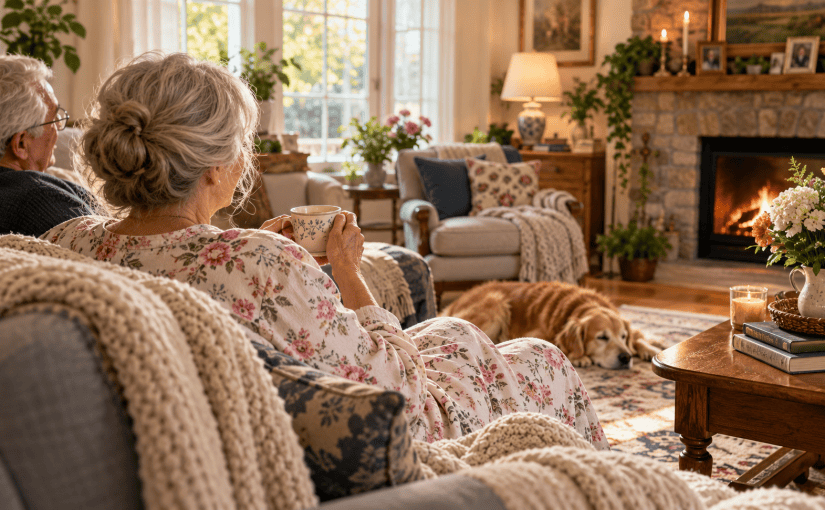
She was wearing a flowered nightgown, the kind that honestly looked more like one of the little dresses young women wear these days.
She apologized for her appearance.
It wasn’t that I couldn’t understand why she was apologizing.
I understood it all too well.
When you feel insecure, sometimes the first thing you do is apologize for the shortcomings you believe other people might see.
But in my eyes, she was absolutely beautiful.
There is something to be said about beauty and aging. About the grace of a woman who has lived a life and shouldn’t have to apologize for being comfortable in her own home.
She told us she’d been ill and had undergone surgery.
She wasn’t sure she’d be able to get out to vote and thought she might need a mail-in ballot.
But she wanted to hear about the candidates.
She wanted to participate.
And that’s when something inside me began to open.
I started talking about Washington County.
Not from a political script.
Not from a campaign advertisement.
But from 26 and a half years of watching a community grow.
I spoke about the changes I’d witnessed, the responsibilities of public service, and why integrity mattered so deeply to me.
I gave my explanation of why I’d chosen to support someone whose approach to leadership I believed in.
For the first time that morning, I wasn’t thinking about whether I could speak to a stranger.
I felt drawn into a conversation with someone whose perspective I wanted to understand.
Someone I wanted to show kindness to.
Someone I wanted to share something meaningful with.
About something I loved.
At one point, she looked down at Hayden’s campaign card.
“Now, he’s a nice-looking young man,” she said.
I smiled and agreed.
That gave me an opening to explain what I’d just learned earlier about Hayden Hill and why I believed he would be a good fit for the position he was running to fill.
Somewhere during that conversation, I noticed a tiny tear in this lady’s eyes.
I’m not sure why it was there.
Perhaps she was emotional about her health.
Perhaps she appreciated having company.
Maybe she was feeling something I recognized in myself.
I’m not going to pretend to know what she was thinking.
But as I sat beside her, I remembered what it felt like to be stuck in a life you no longer recognize.
Stuck in a life you didn’t necessarily choose.
Forced to live a life where your health determined where you could go, what you could do, and how much of the world you could participate in.
A life where you wanted your voice to be heard.
Where you wanted to know you still had enough value to sit at the table and contribute to society.
Dreaming of a life where people would see more of you than whatever was holding you back or disabling you at that moment.
I knew those feelings all too intimately.
And it made me wonder whether, in some small way, she felt some of the same things.
When it was time to leave, her husband offered us cookies or a banana.
We thanked them for their kindness and continued walking.
As we left, Yolanda, one of the women canvassing with me, commented on how my years of experience and personal testimony about Washington County had contributed to the conversation.
And I felt something I hadn’t felt in a long time.
Pride.
Not because I’d persuaded anyone.
But because I’d remembered who I was.
The Beauty of a Second Encounter
A little later, as we made our way back toward our vehicles, we passed the same house again.
The couple was standing outside.
She was still in her flowered nightgown, and her husband was beside her, holding onto her clothing to help steady her.
The tenderness between them was beautiful.
Hayden happened to be walking nearby.
I introduced him.
I told him she’d said he was a good-looking young man, and I was sure his wife would agree.
We all laughed, and I added that while his looks might have caught her attention, his intelligence was the real treasure.
I believed Washington County would be proud to elect someone with his knowledge and experience.
She apologized again for her appearance, and I wondered whether meeting this young man had made her feel a little self-conscious.
I glanced back at her and told her again how beautiful she was and that she had absolutely nothing to apologize for.
Her nightgown looked like one of the dresses all the young ladies wear these days.
In my opinion, she was fashionable, beautiful, and amazing.
She giggled.
And I suddenly realized that I was talking to strangers.
Making someone laugh.
Complimenting a stranger because I genuinely wanted her to know how beautiful I thought she was.
With every conversation, it became more apparent.
The woman I’d missed so desperately was returning.
By this point, Hayden had begun speaking with the couple.
That’s the nature of running for political office. He shared his history and his desire to earn their vote, and when he left, they proudly placed his sign in their front yard.
We all went our separate ways.
Looking back, I realize I had no idea that the most difficult part of the morning was still ahead.
–The Swimming Pool–
I chose to move my car to the nearby parking area in front of the subdivision’s swimming pool.
A pool I had inspected for years.
And that’s when memories of the past came flooding back, haunting my present.
I remembered Cody.
A sweet young man who worked for the POA, someone who had always treated me with kindness and respect.
I remembered looking at a pool pump with him one day when a valve opened and sprayed water directly into my face.
He apologized, and I laughed because earlier that same day, I’d been at a septic system when someone struck a line with a shovel, and sewage water erupted like a geyser.
So when that clean pool water hit my face, all I could think was, Thank God it wasn’t sewage.
I laughed, thinking it would be a story to tell my grandchildren someday.
Those were the memories that made me really love the work I did and the community I was proud of.
Those stories were the kind that never made it into inspection reports.
The personal, honest human connections and conversations were bonuses between the responsibilities of the job.
Cody heard my horrible story in 2024.
Then, in 2025, he asked me to open the pool for the season.
The heartache I suffered when I had to explain that I was no longer allowed to do that work broke me even more.
Yet all he said was that he would pray for me.
I’ve only seen him one time in my community since, at the UPS Store.
I pray to this day that he’s thriving because he’s an incredible human being.
As I sat there in that parking lot, I realized how much I missed him.
A wave of grief ran through me.
I deeply missed not just Cody.
I missed all of it.
The people.
The conversations.
The relationships.
The community and the county I had watched grow for over a quarter of a century.
Suddenly, the pride I’d felt only moments earlier was overwhelmed by grief.
And only in that moment did I realize something I hadn’t fully understood before.
Washington County had been like a first child in my heart.
–Grieving the Loss of My Home–
I moved to Washington County in 1980, after my father’s death.
I grew up here.
It’s where I learned about small-town politics, community relationships, and the importance of knowing the people you serve.
My government career allowed me to find something that had been missing from much of my life.
Strength.
Conviction.
Purpose.
Respect for others and, perhaps most importantly, respect for myself.
It allowed me to stop seeing myself as the abused girlfriend, the woman who had been told she wasn’t smart enough, or someone who needed another person to protect her.
It allowed me to become the person who protected other people.
My career allowed me to grow into the woman I’d always deserved to be.
Through it, I gained respect and confidence. I developed relationships that became part of my identity.
My children grew up knowing me as the woman everyone saw as an expert.
And I loved Washington County with everything I had.
Over the years, I watched empty fields become subdivisions.
Swimming pools get built.
I had the honor of witnessing communities become established, families grow, and people age.
For a quarter of a century, through changes in leadership, government policies, and the enormous growth of Northwest Arkansas, I stood alongside them and never wavered.
I cared for Washington County as if it were my own child.
I watched it take its first steps, learn to drive, go off to college, and build a home.
I protected it fiercely, within the laws and responsibilities of my position.
I was proud that I could put aside my own troubles at times to serve the people within its geographical borders.
There were times those interactions were the very things that allowed me to forget what was happening in my own life.
Yet the hardest thing to grieve is the fact that when I was hurt, the work I loved and the relationships that gave me purpose were taken out of my daily life.
In the very community that felt embedded in my DNA.
I wasn’t given even a single opportunity to say goodbye or find closure.
How do you explain that kind of grief to someone else, or the impact it has on your mental health?
How do you explain losing something that is still there, but you’re no longer part of it, even though you never chose to leave?
The people are still there.
The communities are still there.
The swimming pools are still there.
Life went on.
But I wasn’t part of it anymore.
It felt like raising a child, and then suddenly that child was dead.
I know those are difficult words.
But that’s the depth of the loss I felt.
I wasn’t simply grieving a career.
I was grieving the place where I’d learned to believe in me.
I was grieving my home.
–Becoming Unboxed–
Saturday didn’t magically fix my nervous system.
It didn’t erase the fear, the isolation, or the grief.
There were moments when I still needed someone beside me. Moments when I questioned whether I could participate. Moments when my memories became so overwhelming that I struggled to continue.
But I got up.
I went somewhere unfamiliar.
I asked for help when I needed it.
I sat at a table surrounded by people I didn’t know.
I spoke to strangers.
I laughed.
I remembered what it felt like to be respected for what I knew.
And I cried for everything I missed.
But perhaps the most meaningful part of Saturday was meeting a beautiful woman in a flowered nightgown.
A woman who wanted to hear what we had to say.
A woman whose husband stood beside her with such tenderness.
A woman who made me laugh and whose eyes have stayed with me ever since.
I told her I had a blog.
I hope one day to print this story and bring it back to her door.
Not because I need her to know everything I’ve survived.
But because I want her to know what those few moments meant to me.
I went canvassing because I wanted to reconnect with a county I’d spent my life loving.
I didn’t expect to find a piece of myself sitting in a stranger’s living room.
For so long, I’ve been trying to survive until tomorrow.
Now I’m trying to learn how to believe in myself walking into tomorrow.
Maybe becoming unboxed isn’t about returning to the woman I was before.
Maybe it’s about recognizing that the woman I worked so hard to become is still here.
Even with everything she’s carrying.
Washington County was my first child.
And although I may no longer serve it in the way I once did, I never stopped loving it.
I deserve a seat at the table.
Perhaps, for the first time in what feels like an eternity, I’m beginning to believe my life might be different but that is the only way to truly start Becoming Unboxed.