One of the hardest things for a trauma survivor to do is reach outside their little bubble.
To move beyond the isolation that has started to feel safe.
To reach for another human being.
Another voice on the other end of the line.
Because after trauma, isolation can become comfortable in a strange way. Not because we necessarily want to be alone, but because being alone can feel safer than risking another misunderstanding, another dismissal, another judgment.
Sometimes healing begins with something that looks incredibly small from the outside.
Picking up the phone.
Sending a message.
Telling someone, “I’m not okay.”
And in the beginning of that journey, we are not expecting anyone to heal us.
We are not expecting another person to make us whole. We are not expecting one conversation, one relationship, one therapist, one medication, or one moment to suddenly make everything better.
Most of the time, we simply need someone willing to sit with us.
To listen.
To hear us.
Because something, someone, or some series of events hurt us deeply enough that, for a while, the expression of what happened may feel like one of the only things we still own.
Our words.
Our memories.
Our anger.
Our grief.
Our questions.
Our version of what happened to us.
Sometimes those expressions are all we have left while we are trying to understand who we are now.
That is why the response of the person on the other end matters so much.
It can take enormous courage to finally speak. And sometimes all it takes is one judgment for everything we have expressed outwardly to turn inward.
Suddenly, we are no longer simply saying, “I am hurting.”
We begin asking ourselves whether our pain means something is wrong with us.
Whether we should be further along.
Whether we are failing at recovery.
Whether what happened damaged us so completely that we will never find our way back to ourselves.
Whether we deserve pity instead of respect.
Whether we have somehow become something that should be judged instead of understood.
That is a tremendous amount of power contained in what can look like an ordinary human interaction.
The people we reach toward cannot heal us.
But their response can influence what happens next.
Whether they listen or dismiss.
Whether they stay or retreat.
Whether they make room for us or try to tell us who we should be.
Those moments can affect whether we are willing to reach outward again.
They can affect how safe connection feels.
They can even shape parts of who we become as we rebuild.
But there is another side to this.
No one person can protect another person from everything.
It simply is not possible.
We can stand beside someone.
We can warn them about danger.
We can try to shield them from pain.
We can carry what we are able to carry.
We can love someone so fiercely that we wish we could stand between them and every hurt, every disappointment, every loss, every sadness.
But we cannot live their life for them.
And sometimes, in trying so hard to protect someone we love, we unintentionally stand between them and something they need.
The chance to see clearly.
The chance to make their own choices.
The chance to discover what they are capable of.
The chance to decide what happiness looks like for them.
Protection can come from love.
But so can standing beside someone while allowing them to face what is theirs to face.
Because ultimately, most human beings are searching for many of the same things.
We want to be heard.
We want connection.
We want purpose.
We want some measure of happiness and productivity and the freedom to build a life that feels fulfilling to us.
The American ideal speaks of life, liberty, and the pursuit of happiness.
But happiness has never meant the same thing for everyone.
The clerk standing behind the counter at Dollar General may be every bit as content with their life as the millionaire sitting at the head of Walmart.
And either one can also be profoundly unhappy.
Money cannot tell us.
Titles cannot tell us.
Houses, accomplishments, jobs, and status cannot tell us what fulfillment looks like inside another human being.
And neither can we.
Maybe that is part of what we owe one another.
Not the promise that we can remove every painful thing from someone’s life.
Not the belief that we know what their happiness should look like.
Not the need to rescue, fix, or rewrite them.
Maybe what we owe one another is much simpler.
To listen.
To make room for another person’s expression without immediately turning it into a weakness, a failure, a diagnosis, or a judgment.
To trust that another human being knows something about their own life that we cannot possibly know for them.
To stand beside them without trying to become the author of their story.
There is a difference between saying,
“I will keep everything from touching you,”
and saying,
“Whatever happens, you will not have to face it alone.”
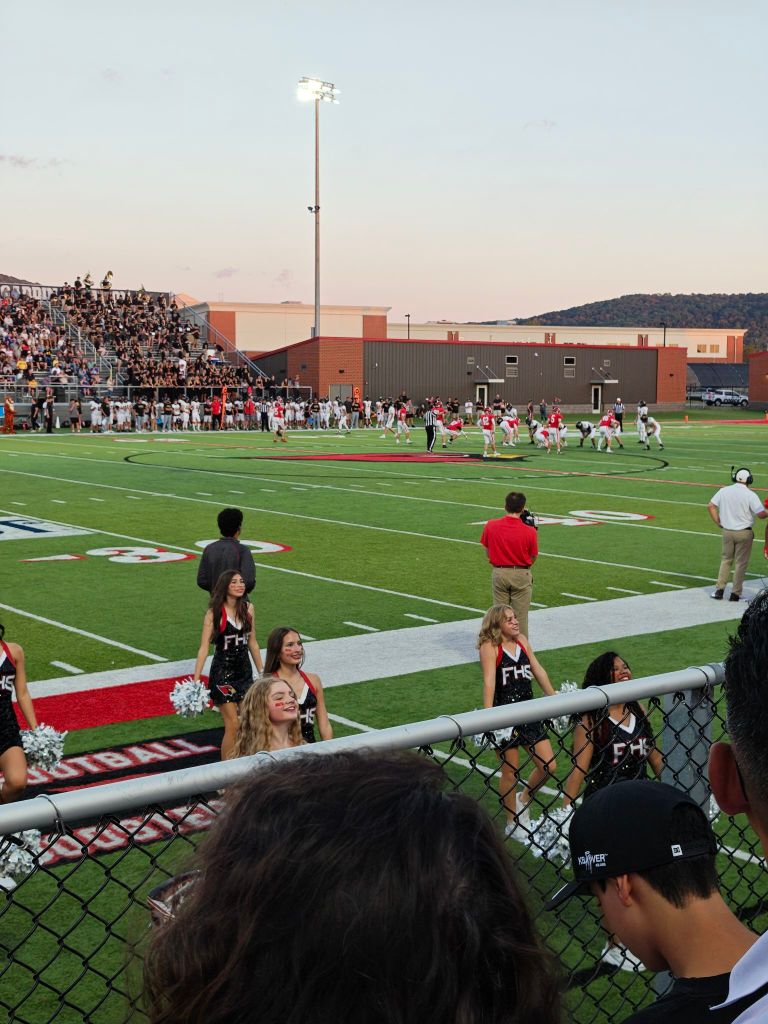
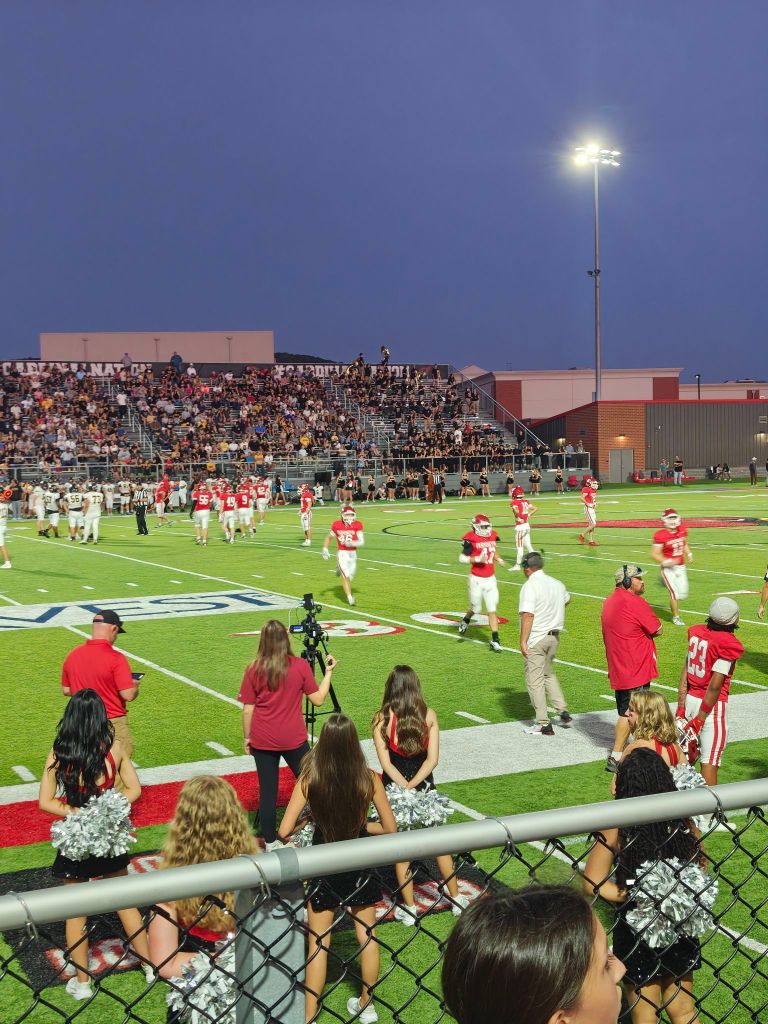
I am here to support my son and his team on a beautiful fall evening. It feels almost surreal that nearly a year ago today, I could sit in these stands without trembling. Back then, I could feel the thud of the players’ feet, the sway of the bleachers, the contagious energy of youth—and still breathe without flinching.
I didn’t know then how sacred that internal calm had been. Back then, I just stayed somewhat numb to avoid the pain.
Now, every sound has a sharp edge. Every rhythm has a painful point my body still doesn’t know how to process it. The air hums with a tension that is somewhat unexplainable. A child keeps blowing a moose horn. I am sure they probably mean for it to distract the other team. Unfortunately for me, each blast feels like it’s aimed straight at my nervous system.
The Farmington High School Cardinals’ home field glows under the Friday night lights. In celebration of every touchdown, fireworks split the dark Ozark sky. They’re breathtaking against the untouched hills that form the backdrop of the stadium. The gentle rolling hills, full of natural beauty, still hide the stadium from the glare of city lights.
Yet for me, every explosion feels like an assault on my senses.
Gabe is a junior and not the starter. This is okay, because time moves like the blink of an eye. This is his last season as the low man on the totem pole. A place almost every adult who has played a sport remembers. With eight minutes left in the second quarter, our team is winning.
It is one of those moments when, as a parent, you find yourself hoping: Maybe he’ll get a chance to play but also realizing that this is someone else’s last season to shine.
After COVID, he found his love for football. When he was little, his autism made sports hard. We tried soccer and baseball. Instead of watching the batter, he would pick flowers in the outfield. Instead of kicking the soccer ball, he would follow the butterfly and go the other way.
So for him to thrive in football last year was incredible. I got to watch him come alive on the field. I got to watch my son find something that lit him up.
That was the first fall after the assault. I was already hypervigilant, but I could still gently calm myself enough to enjoy the energy of the crowd.
Then my employer force-transferred me into a confined, dark, cold closet.
After that, I developed a new kind of fear: agoraphobia.
Now I hear everything.
Every whisper. Every scrape. Every creak.
My ears became too alive, my body too aware. Even now, the faintest sound—a water bottle crinkling, a pen clicking—can feel like a warning:
Danger is near.
Friday night lights Farmington Cardinal Statium
Every touchdown brings another firework, another surge of beauty and panic intertwined. I watch colors bloom across the dark horizon, and I flinch anyway. The crowd cheers, and then the announcer plays “Kickstart My Heart.”
That song came out when I was in high school—when the world still felt wide open and loud in a good way. Hearing it now makes time fold in on itself, my youth and my son’s overlapping in the glow of the Friday night lights. In my mind, I can almost see the girl I was in those stands, laughing and carefree, unaware of what life would take and what it would teach.
The song’s the same, but I’m not.
Now it hits differently much louder somehow, as if it’s reminding me that my son is growing up inside the same rhythm that once carried me, and I’m fighting to stay steady enough to witness it.
My heart won’t stop. My mind won’t stop.
It feels like fighting a mental battle with the cancer of my memories—something that grows inside me without permission, spreading through nerves and thoughts alike. Surviving it feels like chemotherapy for the soul: exhausting, brutal, but necessary if I ever want to live again.
I look out onto the field and notice a girl with green cat-ear headphones snapping pictures of the team. I assume they are for the yearbook. Even though her ears are adorably covered, I notice that she, too, flinches when the fireworks burst.
I wonder if maybe she understands, or maybe she’s simply doing her job. Somehow, the reason doesn’t matter. Noticing her reaction steadies me. It reminds me that I may not be the only one enduring the noise in order to capture something that matters.
When the crowd gets too loud, I retreat to the concession stand and then find myself slipping beneath the bleachers to hide my tears from the world.
I know I am here because I love my son. I also refuse to let fear win.
Mind you, I know every part of me wants to go home. But I choose to stay, even while trembling, breathing too fast, and sick to my stomach. I remind myself that this moment matters.
Fighting through it matters.
Making moments become larger than pain matters.
I know trauma isn’t invisible; it’s physical. The symptoms I experience live in my bones, my pulse, in the way every nerve hums with false alarms. I carry it like a chronic illness—the cancer of memory that threatens to consume what’s left of my peace.
But I keep fighting, even if survival looks nothing like healing.
Tonight, I’m not whole. I’m not calm.
But I’m here.
I’m showing up in a place that once felt safe, even though it still hurts to inhabit. That, for now, is enough.
And as I look around, I wonder how many others are missing these moments.
It is not because they don’t care or because they don’t love deeply. I can promise you that is definitely not the case. The reason is much more complicated. Trauma or anxiety is stealing their sense of safety.
Maybe they’re sitting in parked cars outside stadiums or in dark rooms at home, wishing they could be there but unable to bear the noise from the internal alarm system trauma created.
One can only hope that maybe one day showing up won’t feel like survival for anyone who is suffering. Maybe one day the sun will set on our pain long enough for the celebration to feel like living.
Healing must be conducted personally, but suffering should never have to be.
I want others to know they are truly not sitting in the stands alone.
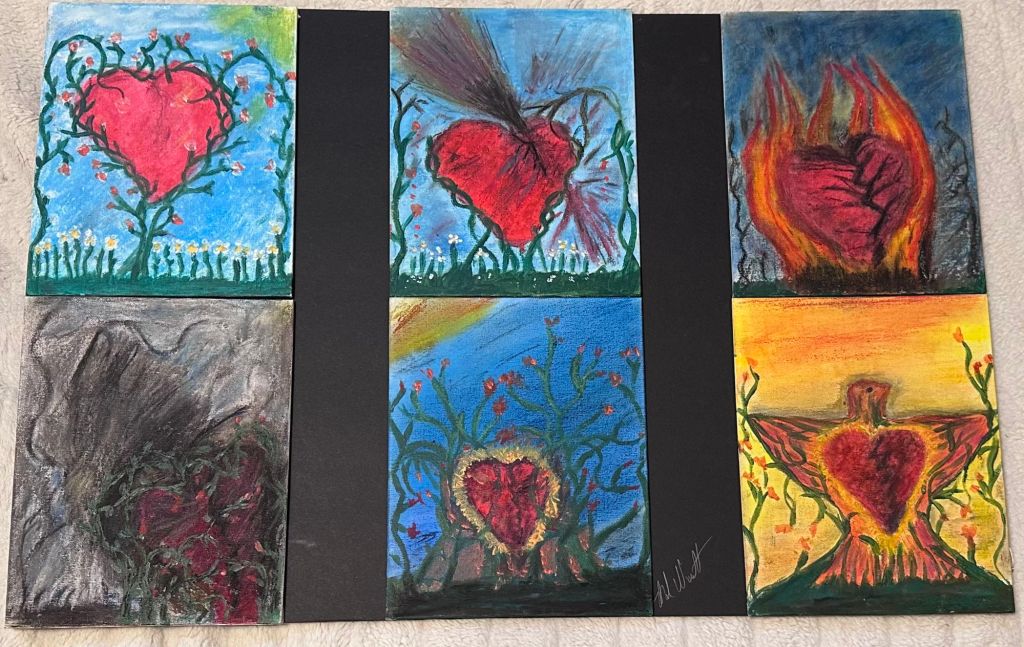
The six hearts came before I understood why there had to be six.
Because how does one heart describe how a beautiful life that once held longing, hope, purpose, and possibility became a battlefield of destruction that no one else could see?
The damage was not visible in my physical appearance, yet internally, I was being torn apart.
One heart could not tell that story. The damage itself could not either. It became a festering wound that tried to kill me slowly enough that even I could barely notice.
The first heart is colorful, vibrant, pure.
It has fine, small, intertwined vines—nothing sharp, nothing controlling. They are simply part of it.
There is an abundance of light. Innocence, love, and happiness without question or delay. Hope grows everywhere. Growth is made of a world of possibilities.
The heart does not question itself. It does not brace for anything. It simply exists.
Safety is natural, normal—a given.
There is an innocent longing.
Hope.
Purpose.
Possibility.
The belief in a happy ending is natural, even when life is difficult. There are dreams that something beautiful is ahead.
The second heart is where life begins to change.
The darkness moves in ever so slowly.
The thorns take root and grow stronger as they thrive on darkness. The painful thorns begin wrapping around the heart, just a little at first.
Not enough to panic.
Not enough to fully understand.
Simply enough to know something is different.
Something is wrong.
The darkness begins moving in. It does not crowd out hope or love, but the heart begins questioning its existence because the thorns have slowly caused pain. The darkness creates force fields and safeguards to protect the heart.
The darkness does not take everything.
There is still light.
There is still a recognizable version of the life that existed before.
But now there is awareness.
Caution.
The darkness begins to numb the senses because love is starting to become painful and frightening.
And this awareness changes everything.
The third heart is the beginning of the end.
Not breaking.
Not shattering.
Melting.
The pain becomes unbearable, far too intense to maintain agrip on hope.
The colors begin to run. The edges no longer hold their shape. The thorns tighten, and the darkness spreads farther across the heart.
There is still something that resembles the mind that once was, but the darkness begins to win, and the heart begins to burn. The darkness no longer controls only itself; it conquers the light as well, nearly burning everything to the ground.
The mind no longer knows how to hold itself together, and with it, the heart begins to be consumed.
This is the part people do not always understand.
A person can still look like themselves while everything inside their mind is collapsing.
Still go to work.
Still answer questions.
Still solve problems.
Still smile when someone speaks and engages them.
They can still be the caregiver.
Still perform the tasks required of an ordinary life.
And all the while, their heart is melting beneath the burning mind, hidden beneath the smiling mask.
The fourth heart is almost entirely consumed by a feelingless numb existence.
It is almost entirely dark.
There is very little hope.
The pain is too great.
Happiness has left.
The heart has allowed so much darkness to enter the mind that the vines are now a circle of thorns, which have nearly swallowed the heart completely. Almost all hope is lost, and the wounds are deep. The mind does not want the heart to be visible. It allows the darkness to surround it.
Yet this is not sadness.
It is something deeper.
The person you once were becomes so distant that the realization sets in, and you begin to wonder whether you ever existed in any version you knew.
There is no clear beginning or ending to the pain anymore.
No clean line between the heart and the darkness of the mind.
Only survival.
Only the smallest remaining spark of the mind, a piece still beating in the heart beneath everything that tried to bury it.
This is the battlefield no one sees.
The one no one should ever have to imagine or experience.
Yet from the outside, no one looks into your eyes and sees the black hole of numbing existence you have fallen into.
From the outside, they believe you are fine.
Sometimes you keep the mask on because even you want to pretend to believe that you are happy.
There may be no blood.
No broken bones.
No visible wound.
Nothing concrete that the world can validate.
Only numbness for the heart and emptiness for the mind.
Inside, everything familiar has been destroyed.
Safety.
Trust.
Identity.
Hope.
The ability to believe your own body when it tells you that you are safe becomes impossible.
This creates the worst wound because somehow, you are still expected to walk through the world as though nothing happened.
Only the fifth heart has some ability to allow hopes light to begin to return.
This occurs by sheer force of will.
A desire to see another sunrise.
A belief that the small spark of sunrise—of hope—is truly a reality and not some sort of cosmic joke.
But the light does not defeat the darkness immediately.
It is a slow, painful process, and it does not occur all at once.
It isn’t dramatic.
Only a very small section of purpose opens.
A sliver of color, light, warmth, and meaning.
The mind becomes a place where the darkness no longer owns everything.
But the heart grows back slowly and smaller. Sometimes a different shape or purpose is the only way growth can begin.
Flowers begin growing around the thorns again—the ones allowed this time around, the ones chosen to help growth have meaning again.
The thorns have not disappeared.
They are evidence that the mind grew differently, more cautiously.
The flowers grow beside the thorns, not to reflect the pain they created, but in spite of them altogether.
The heart is not restored to what it was before.
The mind changed it forever.
Instead, it is becoming something else.
Something better, more relentless, and far more resilient.
Something both wounded and living at the same time.
Fear still exists.
So does grief.
Along with all the memories as proof of existence.
Some days, the darkness still feels closer than anyone wants.
But growth has also brought other things.
Understanding.
Voice.
Connection.
Truth.
And perhaps most importantly, the realization that survival was never supposed to be the end of the story.
The final version of the heart has grown into something extraordinary.
The mind finally realizes it could never return to the version of the heart that existed at the beginning.
Instead, it had to grow into something new.
The untouched light of the first heart is gone.
The mind is different because the first heart believed in possibility without ever having learned darkness or fear.
The final version of the heart believes in possibility because it survived what tried to destroy it.
It also understands that survival is not the same as healing.
Healing does not erase the pain or make it as though it never happened.
The heart carries every stage that came before it.
The darkness was fought against for long enough and hard enough that the heart learned something it did not know before:
Darkness can exist without being allowed to own everything.
The heart begins to live more deeply and more colorfully.
The flowers open again.
The thorns that remain are woven into the landscape by deliberate design. They are not hidden or denied, but they are no longer allowed to decide what grows there.
That is the difference.
Before, life simply happened around the heart.
Now the heart chooses.
What it protects.
What it allows near it.
What it feeds.
What it lets grow.
The darkness did not disappear.
Neither did the memories.
They became part of the landscape instead of the entire horizon.
The heart is no longer melting.
It has found its shape again.
Not the same shape.
Its own shape.
The shape it created after discovering that healing was never going to mean becoming the person who existed before the battlefield.
Growth comes from knowing that the past does not have to be exposed for everything to see, nor does it have to be hidden away as though it never existed.
The past becomes knowledge.
And that knowledge gives hope something it never possessed before:
Information.
The heart now knows there will always be darkness somewhere in the world.
It knows safety can disappear quickly.
So the heart guards itself differently now.
It remembers grief.
Fear.
Numbness.
Complete emptiness.
It does not have the ability to forget what those things felt like.
Yet it still chooses to believe there can be something beautiful ahead.
It fights for growth.
It learns again that there is a world of possibilities.
But because of everything it has been through, it understands something the first heart never had to understand:
Possibility is no longer assumed.
It has to be chosen.
The heart cannot erase the devastation the mind endured during its fight on the battlefield.
But it can allow itself to grow beyond it.
It no longer hides its broken pieces from the world.
It wears them as evidence that it survived.
The scars do not have to be discarded or covered because harm is not something that simply disappears when it is locked away.
Given the right light, the right sun, and the right direction, even the places shaped by pain can become part of something living.
The heart gets to decide what remains.
Some thorns become boundaries.
Some are no longer given space.
Some of what once represented pain becomes evidence of growth.
And none of it has to be carried with shame.
The broken pieces are not proof that the heart became less beautiful.
They became part of something far more beautiful than it ever imagined it could become.
This is why the heart allows flowers to grow again.
Because this time, it wants them there.
The flowers are not accidental.
Neither is the light.
They are chosen.
The heart allows the mind to build around the thorns without pretending they never existed.
It decides which ones remain as boundaries and which ones no longer deserve space.
The flowers grow because they are wanted there.
The light exists because the heart fought long enough to find it again.
This heart is not evidence that I returned to who I was.
It is evidence that I became someone I could not have imagined before.
Not untouched.
Not without scars.
Not without darkness.
But alive.
Aware.
Choosing.
Growing.
Becoming mine.
Maybe that is why there had to be six.
One heart could have shown pain.
One heart could have shown recovery.
But one heart could never have shown the entire war.
The innocence.
The warning.
The collapse.
The disappearance.
The return.
The becoming.
For so long, I looked at what happened to me as evidence that something inside me was defective.
I saw the panic.
The anger.
The confusion.
The exhaustion.
The hypervigilance.
The pieces of myself I could no longer reach.
And I blamed the heart for what had wrapped itself around it.
There is something deeply human about the way we hide our suffering.
It is not vanity. It is not pride. It is fear. Ancient and instinctive. The fear that if others see how much we are hurting, they will decide we are no longer worthy of standing where we once stood. That our pain disqualifies us. That our suffering is evidence of weakness rather than survival.
So we learn to tuck it away. We learn to smile carefully. We learn which parts of ourselves are acceptable to show and which parts must remain hidden, even in the moments when we need connection the most. Suffering becomes private not because it is shameful, but because the world has taught us that pain invites judgment.
And judgment isolates.
As I began my healing journey, still very early, incredibly fragile, somewhere in the first steps of learning how to live inside my own mind again. After the chaos and harm of the past few years of torment and self judgement; I found myself reaching outward. Not widely. Carefully. Toward the people who had reached for me before, even briefly. A call here. A text there. Small gestures that carried enormous weight.
One person, in particular, kept returning to my thoughts.
I had known her for nearly a quarter of a century, a lifetime by many measures. I could remember the first inspection we ever did together. I was still green, still learning, and she was brand new. Back then, even if you were fresh at your job, you taught the next person who walked through the door. We walked into a restaurant so infested with cockroaches that when you pulled the paper towels from the dispenser, the roaches came spilling out with them.
It was horrific.
And yet, it was also a place of happiness for her. It was where she had gone after getting engaged to the man who would become her lifelong partner. Someone who would stand beside her through everything that came after. I remember thinking, even then, that she had found something rare. I never envied her for it, but I noticed it. I admired it. I always had.
Over the decades, she became woven into the fabric of my life. She came to my wedding. She arrived as a brand-new mother of her second child, carrying that soft, luminous exhaustion that only new mothers have. I still remember how her face glowed illuminating beauty. A lot of pride and exhaustion all wrapped into one. Her smile carried warmth, happiness into the room. I remember how deeply it mattered to me that she was there, standing beside me in that moment of my life. Not out of obligation, but because she chose it. I realized presence is its own form of loyalty.
After that, she came to my son’s first birthday.
It was one of those ordinary milestones that doesn’t feel ordinary when you look back—balloons, laughter, the chaos of a one-year-old discovering the world. And there she was again. Showing up. Witnessing. Standing inside the small, meaningful moments that quietly build a life.
Those memories stayed with me.
And then, at one point in her life, she became ill.
Cancer.
The word itself carries judgment, whether we admit it or not. The world looked at her differently—not because of who she was or what she had built, but because she had been sick. People quietly decided she was no longer capable. No longer reliable. No longer the same.
Watching that happen to her impacted me. And now, as I look back, I realize she probably understood what I am going through now more than almost anyone else ever could.
Because I, too, have been judged not by my competence or my history, but by my pain. I have been treated as though being hurt means being diminished. As though suffering cancels out worth. And when institutions reinforce that lie, the trauma mind absorbs it. Begins to believe it. Begins to whisper that maybe they are right.
—Still, even during my darkest years, the years I wanted to give up and give the world a pass and just let the darkness absorb me, even when I couldn’t see in myself what I outwardly carried, she would tell me she envied my strength.
Strength, in my world, has never been abstract. I have a daughter with diabetes, and I have raised a son who taught me that every child asks something different of their mother. It required different patience, different advocacy, different ways of staying steady when life gets hard.
A diabetic child is a whole different layer of trauma and fear. It was measured in blood sugar checks and sleepless nights, in vigilance that never turns off, in learning how to stay calm when your child’s life depends on your steadiness. My friend saw that. She named it in words that have never left me., “They say God doesn’t give you more than you can handle,but sometimes I’m not sure what God’s plan was for you.“
She didn’t say it lightly. She didn’t say it cruelly. She said it with awe. With concern. With the quiet recognition that what I had been asked to carry was heavy—perhaps heavier than anyone should have to bear.
At the time, I didn’t know how to receive that. Trauma has a way of convincing you that endurance is not strength, just obligation. That surviving does not count if you are exhausted while doing it.
Something in me kept thinking of her. It was the same quiet, persistent pull I’ve felt my whole life. A mental pull, the one my grandmother, Rose used to talk about. She would call one of her children or grandchildren by the wrong name, then laugh and say, “They must be thinking of me” And most of the time, she was right. Someone would call. Someone would show up. Time and distance would collapse into closeness.
I think I inherited that from her. That empathetic sixth sense. The feeling in the pit of my stomach when someone’s name won’t let go.
So I reached out.
She is a cancer survivor, nearly ten years strong. But survival does not always erase the fear. The possibility of its return can linger quietly in the back of the mind, creating its own kind of darkness. Doubt. Questions about value. Questions about the future. Questions about whether the world might once again reduce a person to a diagnosis.
I want to stand beside her.
Because her illness never diminished her worth. It shook her confidence. It challenged her sense of self. But it did not erase the truth of who she is deep inside; a remarkable mother, a devoted partner, a capable leader, a woman who built something extraordinary even when fear told her she might lose everything.
During the recession, she worried she wouldn’t be able to feed her family. Later, she and her husband built an empire. An empire she still doesn’t fully recognize as evidence of her own strength. Suffering has a way of blinding us to our greatness. It teaches us to fixate on the fractures and ignore the structure still standing.
And here I am still isolated, still crying, unable to put up my Christmas decorations because I don’t yet know how to feel joy again. I don’t know how to live the way I once did. But I want joy for her. I want peace for her. I want her to see what I see.
I want her to know that what the world calls kryptonite was never weakness at all.
Trauma does not require a single violent incident to nearly destroy us. It can come from prolonged judgment. From betrayal by systems we trusted. From having our identities questioned and our value reduced to what we can produce rather than who we are.
A lawsuit can be trauma. An institution turning against you can be trauma. Having your faith in yourself put on trial can be trauma.
Kindness, then, becomes resistance.
Standing beside someone and saying, I see you. I know your strength. You are still worthy, is not softness. It is defiance against a world that confuses suffering with failure.
Watching my friend continue to fight, continue to live, to build, to love someone who internally feels so unlovable as me, helps inch me closer to remembering the life I once had. The strength I outwardly showed the world that I couldn’t internally allow myself to feel. It allows joy to return slowly, alongside the pain, rather than being consumed by it.
And maybe that is how healing works.
Not all at once. Not loudly.
But through remembering one another.
Through refusing to let suffering be the final word.
Through choosing to see strength where the world looks away.
By building strength in those around us, by remembering that everyone is fighting an internal battle, and by rolling up our own sleeves to help the person beside us, that strength may become bright enough to light the way.
So as I was working on an old door today—a vintage door, I’m not sure how old it is, but it looks like it was probably an exterior door with a single pane of glass in the middle—it hit me.
It’s one of those things I bought because I knew I would do something with it someday. And then everything happened.
Now it has become one more project that sat too long—whether from procrastination, exhaustion, trauma, or simply life getting in the way. And maybe that’s me too.
I don’t feel very yellow brick road right now.
And the sad part is, I had so many good words in me today.
Most people look at things as disposable. At least in today’s world, that’s what it feels like anyway.
There are a lot of people who would ask themselves, what’s the point in fighting for something that has three layers of paint on it when it would be easier to simply replace it?
Maybe that’s part of why I see the world with rose-colored glasses.
But I guess the thing people misunderstand about rose-colored glasses is that it doesn’t mean you think everything is always beautiful.
Sometimes it simply means you can still see beauty in something after it has been neglected.
Because that door has a story. Just like any of us do.
Whether it’s a person or a thing, from the moment we are born—or built—everything begins to shape us into what we become.
As I worked on this door, I used two containers of paint remover. The battery kept dying on my electric sander. The sandpaper was too fine and couldn’t get down into the deeper grooves.
And the weathered side of that door—the side that had taken the beating—held onto that paint like it had fused into its DNA.
No matter how much stripper I put on it, that paint was ingrained.
At least the top layer was easily removable, and didn’t put up a fight. That of course was just the visible superficial layer, that layer that the world sees without having to dig too deep or as too many questions.
And somewhere in the middle of removing the visual easy superficial paint, I started to see myself.
There were layers and layers of difficult, complicated things that had attached themselves to me over time.
Things that harmed me.
Things that changed the way I move through the world.
Things my own mind still struggles to fully comprehend sometimes.
And over time, it made me feel weathered too.
Worn.
Like life had sat on me a little too long.
And I guess I began to realize that the final layer—that deep-seated, rooted, hard-to-remove layer of paint—was the part of me that feels like the trauma of the last couple of years.
Because the more I worked on that door, the more I could see the beauty underneath it.
The grain.
The movement.
The oak waving through in places where the paint finally gave up.
And what struck me was that those lines weren’t man-made.
They were created by nature.
They were the backbone of that door.
Its original structure.
Its truth.
At one point, it was a living thing until it was cut down and turned into something meant to become useful—maybe even beautiful—to someone else.
And that made me think about how healing from complex post-traumatic stress disorder—complex PTSD—is not simple.
Complex PTSD can develop through repeated or prolonged trauma, where painful experiences layer themselves into the mind and body over time.
It is not one event.
It is not one wound.
It is not one memory.
Every layer you remove exposes another layer underneath it.
And just like I fought to get the paint off that door, I fight to understand what caused all of it underneath me.
Why I react the way I do.
Why certain things still live in my body.
Why some pain is surface-level and some pain feels like it has soaked so far in that you don’t know if it can ever fully be stripped away.
Now the average human—and I don’t say that with disrespect—would say enough is enough. They would have thrown the door away.
I fought with that door for five days, and I’m still not done. And it still needs repair.
But then again… I’d say that about me too. And maybe that’s the point.
Maybe the point isn’t that it should have been easy.
Maybe the point isn’t whether it would be cheaper, faster, or more practical to replace it.
Maybe the point is that some things still deserve to be saved.
Not because they are perfect.
Not because they are convenient.
Not because they haven’t been damaged.
But because underneath all the layers, there is still something solid there.
Still something real.
Still something worth bringing back to life.
As I continued to sand the door, I noticed something else.
The layers of damage were deepest in the most delicate parts of it—the places with the most detail, the places that had the most exposure to the harshness of the world.
And I realized I had come to a crossroads:
Do I repair it until it looks like new?
Or do I sand it and allow the finished product to still carry evidence of what time and neglect had done?
That question hit me harder than I expected.
Because I realized that in me, too, every layer exposed through this journey has left jagged places and missing pieces—things a Band-Aid could never simply cover.
As I looked at that door, I saw the pitted sections.
The softened places.
The rotten wounds.
And I realized that with grace, time, and just the right amount of pressure, even damaged things can still become something.
I think my complex PTSD was shaped, in part, by all the years I never allowed myself the time to heal.
I always rushed.
I, like that door, spent so much of my life shielding others from the harsh elements that I never stopped long enough to deal with what all of it was doing to me.
I tried too fast and too hard to get over things.
To be fine. To function. To keep going.
They are there as proof.
To pretend the weather had not reached all the way in.
But this time, just like that door—the one that had been discarded as useless, too far gone, too much of a burden to repair—I finally see something different.
The scars are not proof that it is ruined.
They are evidence that it made it through the storm.
I also realized, while working on that door, that some of the wood had been too weathered to survive.
As I sanded, parts of the rotted edges came away.
And that made me think about something I had not fully put into words before:
Was the goal to make it look new again?
To repair it so completely that someone else would never know the original damage had ever occurred?
At first, that feels like the right answer.
But the more I thought about it, the more I realized that doing that would also remove the real story.
The real truth.
Because nothing once damaged is ever truly new again.
And maybe that is not failure. Maybe that is simply reality.
Maybe beauty was never supposed to come from pretending the storm never happened.
Maybe beauty comes from surviving it.
Not by announcing every scar.
Not by turning every wound into an identity.
Notby using pain as a shield of protection the way I once did. But by understanding that the scars are not there to make me harder.
Proof that I still exist in spite of the harsh elements that once tried to wear me down. And maybe the most sacred realization of all is this:
That on the inside, the softer parts of me—
the healthy parts,
the loving parts,
the hopeful parts,
the parts that still wanted beauty, connection, gentleness, and peace— those were the parts worth protecting all along.
Not the armor.
Not the survival mode.
Not the shell.
The softness.
The softness was never a weakness.
It was the part of me that survived.
And maybe healing is not about pretending the weather never touched you.
Maybe it’s about stripping away what was never supposed to stay on you in the first place.
Maybe it’s about realizing that the deepest parts of who you are were never the damage.
They were always the grain.
They were always the oak.
They were always the part that remained after everything else started coming off.
And maybe that’s why I keep fighting with old doors.
Maybe that’s why I keep fighting with myself.
Because somewhere underneath the exhaustion, the fear, the anger, the grief, the years of surviving, the shutting down, the hypervigilance, the overthinking, the numbness, and the scars…
Iknow there is still something beautiful under there.
Not untouched.
Not unbroken.
But beautiful all the same. And maybe the world would call it too much work.
But I don’t.
Because I know what it means to look at something weathered and still see its worth.
People have often asked me how it is that I’m able to remember so many details.
The truth is, I don’t remember quite as well as I once did. A lifetime of incredibly difficult and unusual circumstances, wrapped up in the word trauma, changed the way my mind holds onto things.
Trauma has a way of affecting even someone who once could catalog everything in their mind down to the smallest detail.
That does not make me extraordinarily brilliant.
Quite the contrary.
I learned that much of my ability to remember came from my life circumstances. Somewhere along the way, remembering became one of the most important parts of me.
Maybe it came from what life threw at me.
Maybe it came from something much simpler.
I never wanted to be forgotten.
Maybe that is part of why I learned to remember so much. I remembered the details of people—their words, their faces, the things that mattered to them—because remembering felt important.
If I remembered you, you mattered. And somewhere inside me, I wanted to know that I mattered enough to be remembered too.
Remembering was also a defense mechanism because I never wanted to allow myself to become trapped, questioned, or ridiculed in a harmful situation again.
It is hard to explain what it feels like to have a mind shaped by trauma while trying to work through it, heal from it, and explain to others how deeply life’s experiences can become ingrained—so deeply that they are physically felt too.
I can often remember the sounds from an event—the flashes of light, the temperature—before I remember the words in the conversation.
I can remember the feeling in my chest before I remember the words someone spoke to me.
I can remember how the light shined.
I can remember their faces as they walked out of the room.
And sometimes I can still almost see the silence—the cold shoulder, the lack of empathy or care, the way someone can throw silence at you.
Maybe this is simply one of the skills a trauma survivor develops.
I can remember the weight of each moment as though my nervous system were keeping its own journal, a record of both positive and negative memories.
Other people may be able to remember joy simply as happiness. I often feel as though I remember all of it—the joy, the fear, the atmosphere, the weight of the moment—as though my nervous system is always keeping score because it never completely rests.
Maybe that is because I don’t simply remember what happened.
I experience it over and over again.
There is another part that has always been difficult to explain, and sometimes it can make you feel incredibly alone.
What can feel like a trauma survivor’s superpower is the nervous system’s ability to brace and sense, with every fiber of your being, the potential danger that may be around you.
Is that why, when I see memories, it feels as though I’m watching a movie from the outside?
Watching every scene of that memory, whether it is positive or negative?
Is that why I need to remember the whole thing?
But remembering everything is painful—the bad and the good.
Maybe that is part of why surviving trauma can feel so lonely. Life itself can become a painful, constantly on-guard experience.
It is hard to explain how you can see yourself standing somewhere and know what is about to happen. As you watch every moment unfolding in the past, you wish you could reach through the screen of your mind and change the ending.
I can’t.
No one who has survived incredibly difficult and complicated circumstances, all wrapped up in the word trauma, and made it to the other side can reach backward and change what happened.
Even though every fiber of your being can make it feel as though it is happening again, the movie always plays the same way.
For many years, I wondered if something was wrong with me because my memories felt different. My descriptions felt deeper.
My words seemed to touch people as I told them the complicated stories of life with a passion that made them want to hear more.
I suppose it is only now that I understand that this is simply the way my mind learned to survive something overwhelmingly painful.
It is through this realization that I have changed the way I look at myself.
I no longer judge myself because a sound makes my heart race or because a memory arrives carrying the same physical sensations it carried the first time around.
I understand now that my body was paying attention even when my mind was desperately trying to survive.
Maybe that is why I remember so much. My memories were never stored only as stories. They were stored as sounds.
As sensations.
As images.
As fear.
As silence.
And remembering is painful whether the memory is bad or good.
Maybe this is what defines trauma healing and why it is so painful, because the pain is what stops or stalls the healing process.
So for now, I write these stories not because I could change anything when those things happened, but because I am no longer trapped as the woman inside those scenes.
Now I am also the woman watching—and healing in the process.
My hope is that, as you read these stories, you see yourself not in my incredibly difficult circumstances or trauma, but as the individual trying to change your own scene, grow, and heal outside of the trauma that has defined so much of your life.
Maybe healing is learning that trauma can be part of your story without being the only thing that defines you.

 Becoming Unboxed