
Friday Night Lights


Friday Night High school Football

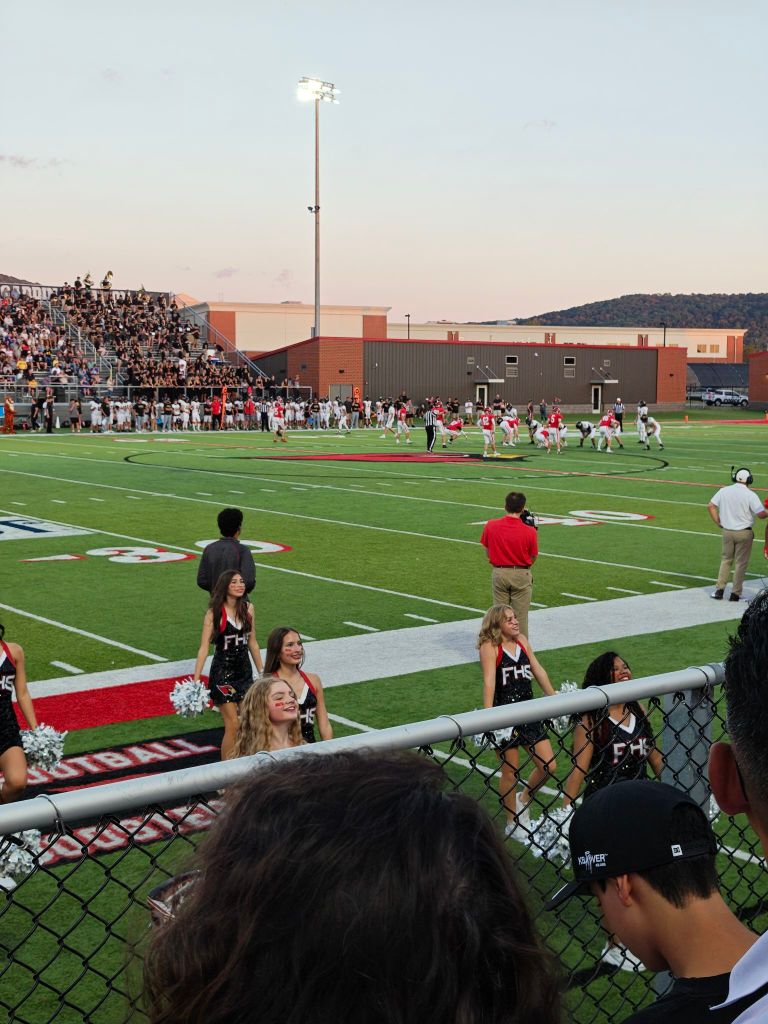
I am here to support my son and his team on a beautiful fall evening. It feels almost surreal that nearly a year ago today, I could sit in these stands without trembling. Back then, I could feel the thud of the players’ feet, the sway of the bleachers, the contagious energy of youth—and still breathe without flinching.

I didn’t know then how sacred that internal calm had been. Back then, I just stayed somewhat numb to avoid the pain.

Now, every sound has a sharp edge. Every rhythm has a painful point my body still doesn’t know how to process it. The air hums with a tension that is somewhat unexplainable. A child keeps blowing a moose horn. I am sure they probably mean for it to distract the other team. Unfortunately for me, each blast feels like it’s aimed straight at my nervous system.

The Farmington High School Cardinals’ home field glows under the Friday night lights. In celebration of every touchdown, fireworks split the dark Ozark sky. They’re breathtaking against the untouched hills that form the backdrop of the stadium. The gentle rolling hills, full of natural beauty, still hide the stadium from the glare of city lights.

Yet for me, every explosion feels like an assault on my senses.

Gabe is a junior and not the starter. This is okay, because time moves like the blink of an eye. This is his last season as the low man on the totem pole. A place almost every adult who has played a sport remembers. With eight minutes left in the second quarter, our team is winning.

It is one of those moments when, as a parent, you find yourself hoping: Maybe he’ll get a chance to play but also realizing that this is someone else’s last season to shine.

After COVID, he found his love for football. When he was little, his autism made sports hard. We tried soccer and baseball. Instead of watching the batter, he would pick flowers in the outfield. Instead of kicking the soccer ball, he would follow the butterfly and go the other way.

So for him to thrive in football last year was incredible. I got to watch him come alive on the field. I got to watch my son find something that lit him up.

That was the first fall after the assault. I was already hypervigilant, but I could still gently calm myself enough to enjoy the energy of the crowd.

Then my employer force-transferred me into a confined, dark, cold closet.

After that, I developed a new kind of fear: agoraphobia.

Now I hear everything.

Every whisper. Every scrape. Every creak.

My ears became too alive, my body too aware. Even now, the faintest sound—a water bottle crinkling, a pen clicking—can feel like a warning:

Danger is near.
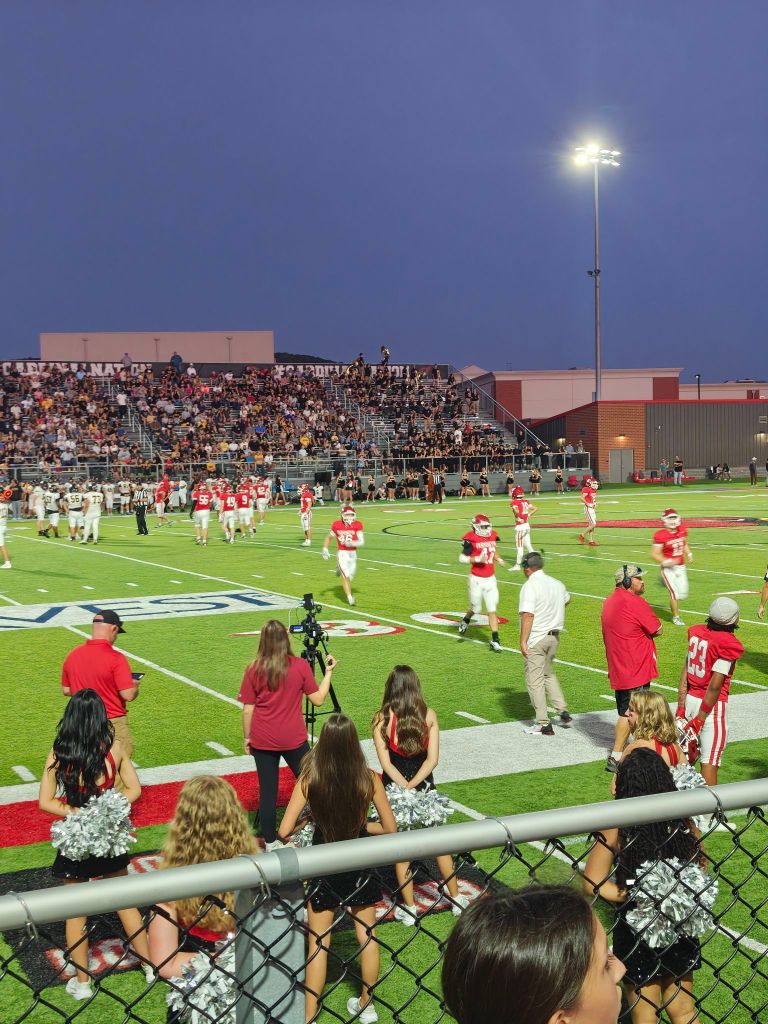
Friday night lights Farmington Cardinal Statium


Every touchdown brings another firework, another surge of beauty and panic intertwined. I watch colors bloom across the dark horizon, and I flinch anyway. The crowd cheers, and then the announcer plays “Kickstart My Heart.”

That song came out when I was in high school—when the world still felt wide open and loud in a good way. Hearing it now makes time fold in on itself, my youth and my son’s overlapping in the glow of the Friday night lights. In my mind, I can almost see the girl I was in those stands, laughing and carefree, unaware of what life would take and what it would teach.

The song’s the same, but I’m not.

Now it hits differently much louder somehow, as if it’s reminding me that my son is growing up inside the same rhythm that once carried me, and I’m fighting to stay steady enough to witness it.

My heart won’t stop. My mind won’t stop.

It feels like fighting a mental battle with the cancer of my memories—something that grows inside me without permission, spreading through nerves and thoughts alike. Surviving it feels like chemotherapy for the soul: exhausting, brutal, but necessary if I ever want to live again.

I look out onto the field and notice a girl with green cat-ear headphones snapping pictures of the team. I assume they are for the yearbook. Even though her ears are adorably covered, I notice that she, too, flinches when the fireworks burst.

I wonder if maybe she understands, or maybe she’s simply doing her job. Somehow, the reason doesn’t matter. Noticing her reaction steadies me. It reminds me that I may not be the only one enduring the noise in order to capture something that matters.

When the crowd gets too loud, I retreat to the concession stand and then find myself slipping beneath the bleachers to hide my tears from the world.

I know I am here because I love my son. I also refuse to let fear win.

Mind you, I know every part of me wants to go home. But I choose to stay, even while trembling, breathing too fast, and sick to my stomach. I remind myself that this moment matters.

Fighting through it matters.

Making moments become larger than pain matters.

I know trauma isn’t invisible; it’s physical. The symptoms I experience live in my bones, my pulse, in the way every nerve hums with false alarms. I carry it like a chronic illness—the cancer of memory that threatens to consume what’s left of my peace.

But I keep fighting, even if survival looks nothing like healing.

Tonight, I’m not whole. I’m not calm.

But I’m here.

I’m showing up in a place that once felt safe, even though it still hurts to inhabit. That, for now, is enough.

And as I look around, I wonder how many others are missing these moments.

It is not because they don’t care or because they don’t love deeply. I can promise you that is definitely not the case. The reason is much more complicated. Trauma or anxiety is stealing their sense of safety.

Maybe they’re sitting in parked cars outside stadiums or in dark rooms at home, wishing they could be there but unable to bear the noise from the internal alarm system trauma created.

One can only hope that maybe one day showing up won’t feel like survival for anyone who is suffering. Maybe one day the sun will set on our pain long enough for the celebration to feel like living.

Healing must be conducted personally, but suffering should never have to be.

I want others to know they are truly not sitting in the stands alone.

I am right there next to you.

Let’s move toward healing together.

The Strength We Hide

There is something deeply human about the way we hide our suffering.

It is not vanity. It is not pride. It is fear. Ancient and instinctive. The fear that if others see how much we are hurting, they will decide we are no longer worthy of standing where we once stood. That our pain disqualifies us. That our suffering is evidence of weakness rather than survival.

So we learn to tuck it away. We learn to smile carefully. We learn which parts of ourselves are acceptable to show and which parts must remain hidden, even in the moments when we need connection the most. Suffering becomes private not because it is shameful, but because the world has taught us that pain invites judgment.

And judgment isolates.

As I began my healing journey, still very early, incredibly fragile, somewhere in the first steps of learning how to live inside my own mind again.  After the chaos and harm of the past few years of torment and self judgement; I found myself reaching outward. Not widely. Carefully. Toward the people who had reached for me before, even briefly. A call here. A text there. Small gestures that carried enormous weight.

One person, in particular, kept returning to my thoughts.

I had known her for nearly a quarter of a century, a lifetime by many measures. I could remember the first inspection we ever did together. I was still green, still learning, and she was brand new. Back then, even if you were fresh at your job, you taught the next person who walked through the door. We walked into a restaurant so infested with cockroaches that when you pulled the paper towels from the dispenser, the roaches came spilling out with them.

It was horrific.

And yet, it was also a place of happiness for her. It was where she had gone after getting engaged to the man who would become her lifelong partner. Someone who would stand beside her through everything that came after. I remember thinking, even then, that she had found something rare. I never envied her for it, but I noticed it. I admired it. I always had.

Over the decades, she became woven into the fabric of my life. She came to my wedding. She arrived as a brand-new mother of her second child, carrying that soft, luminous exhaustion that only new mothers have. I still remember how her face glowed illuminating beauty. A lot of pride and exhaustion all wrapped into one. Her smile carried warmth, happiness  into the room. I remember how deeply it mattered to me that she was there, standing beside me in that moment of my life. Not out of obligation, but because she chose it. I realized presence is its own form of loyalty.

After that, she came to my son’s first birthday.

It was one of those ordinary milestones that doesn’t feel ordinary when you look back—balloons, laughter, the chaos of a one-year-old discovering the world. And there she was again. Showing up. Witnessing. Standing inside the small, meaningful moments that quietly build a life.

Those memories stayed with me.

And then, at one point in her life, she became ill.

Cancer.

The word itself carries judgment, whether we admit it or not. The world looked at her differently—not because of who she was or what she had built, but because she had been sick. People quietly decided she was no longer capable. No longer reliable. No longer the same.

Watching that happen to her impacted me. And now, as I look back, I realize she probably understood what I am going through now more than almost anyone else ever could.

Because I, too, have been judged not by my competence or my history, but by my pain. I have been treated as though being hurt means being diminished. As though suffering cancels out worth. And when institutions reinforce that lie, the trauma mind absorbs it. Begins to believe it. Begins to whisper that maybe they are right.

—Still, even during my darkest years, the years I wanted to give up and give the world a pass and just let the darkness absorb me, even when I couldn’t see in myself what I outwardly carried, she would tell me she envied my strength.

Strength, in my world, has never been abstract. I have a daughter with diabetes, and I have raised a son who taught me that every child asks something different of their mother. It required different patience, different advocacy, different ways of staying steady when life gets hard. 

A diabetic child is a whole different layer of trauma and fear. It was measured in blood sugar checks and sleepless nights, in vigilance that never turns off, in learning how to stay calm when your child’s life depends on your steadiness. My friend saw that. She named it in words that have never left me., “They say God doesn’t give you more than you can handle,  but sometimes I’m not sure what God’s plan was for you.

She didn’t say it lightly. She didn’t say it cruelly. She said it with awe. With concern. With the quiet recognition that what I had been asked to carry was heavy—perhaps heavier than anyone should have to bear.

At the time, I didn’t know how to receive that. Trauma has a way of convincing you that endurance is not strength, just obligation. That surviving does not count if you are exhausted while doing it.

Something in me kept thinking of her. It was the same quiet, persistent pull I’ve felt my whole life. A mental pull, the one my grandmother, Rose used to talk about. She would call one of her children or grandchildren by the wrong name, then laugh and say, “They must be thinking of me” And most of the time, she was right. Someone would call. Someone would show up. Time and distance would collapse into closeness.

I think I inherited that from her. That empathetic sixth sense. The feeling in the pit of my stomach when someone’s name won’t let go.

So I reached out.

She is a cancer survivor, nearly ten years strong. But survival does not always erase the fear. The possibility of its return can linger quietly in the back of the mind, creating its own kind of darkness. Doubt. Questions about value. Questions about the future. Questions about whether the world might once again reduce a person to a diagnosis.

I want to stand beside her.

Because her illness never diminished her worth. It shook her confidence. It challenged her sense of self. But it did not erase the truth of who she is deep inside; a remarkable mother, a devoted partner, a capable leader, a woman who built something extraordinary even when fear told her she might lose everything.

During the recession, she worried she wouldn’t be able to feed her family. Later, she and her husband built an empire. An empire she still doesn’t fully recognize as evidence of her own strength. Suffering has a way of blinding us to our greatness. It teaches us to fixate on the fractures and ignore the structure still standing.

And here I am still isolated, still crying, unable to put up my Christmas decorations because I don’t yet know how to feel joy again. I don’t know how to live the way I once did. But I want joy for her. I want peace for her. I want her to see what I see.

I want her to know that what the world calls kryptonite was never weakness at all.

Trauma does not require a single violent incident to nearly destroy us. It can come from prolonged judgment. From betrayal by systems we trusted. From having our identities questioned and our value reduced to what we can produce rather than who we are.

A lawsuit can be trauma.
An institution turning against you can be trauma.
Having your faith in yourself put on trial can be trauma.

Kindness, then, becomes resistance.

Standing beside someone and saying, I see you. I know your strength. You are still worthy, is not softness. It is defiance against a world that confuses suffering with failure.

Watching my friend continue to fight, continue to live, to build, to love someone who internally feels so unlovable as me, helps inch me closer to remembering the life I once had. The strength I outwardly showed the world that I couldn’t internally allow myself to feel. It allows joy to return slowly, alongside the pain, rather than being consumed by it.

And maybe that is how healing works.

Not all at once.
Not loudly.

But through remembering one another.

Through refusing to let suffering be the final word.

Through choosing to see strength where the world looks away.

By building strength in those around us, by remembering that everyone is fighting an internal battle, and by rolling up our own sleeves to help the person beside us, that strength may become bright enough to light the way.